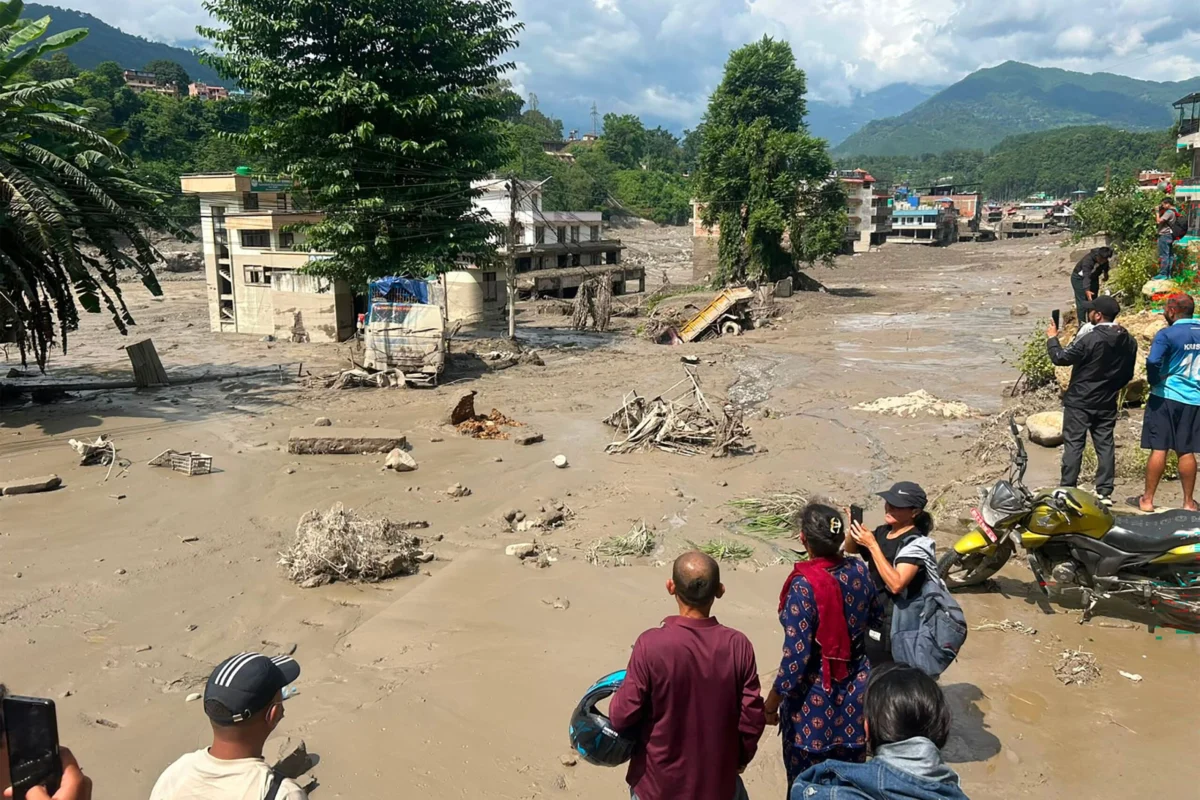
KATHMANDU, Nepal — A remote, mountainous region straddling the border between Nepal and Tibet has become the site of a harrowing environmental tragedy. On Wednesday, a massive, sudden deluge of water, ice, and debris tore through the valley, leaving a trail of devastation that has claimed at least 160 lives. As search-and-rescue teams comb through miles of sludge and wreckage, hundreds of people remain missing, including dozens of international tourists who were caught in the path of what experts describe as a catastrophic glacial collapse.
The disaster serves as a grim manifestation of the climate crisis, providing a lethal demonstration of how the world’s "third pole"—the Himalayan region—is becoming increasingly unstable as global temperatures rise.
The Anatomy of a Disaster: Main Facts
The flooding event was not a typical monsoon-driven deluge, but a high-altitude collapse of unprecedented ferocity. Initial analysis of satellite imagery, corroborated by reports from the Nepalese government, suggests that the trigger was a colossal ice avalanche. A section of a glacier, estimated by geologists to be 2,000 feet wide, sheared off from the mountain face.
The block of ice plummeted nearly 4,000 feet into the valley below. The sheer kinetic energy of the fall effectively "pulverized" the ice, transforming it into a high-velocity slurry of water and debris. The impact was so severe that it registered as a magnitude 5.2 seismic event on the sensors of the U.S. Geological Survey.
For the communities below, there was virtually no warning. Social media footage emerging from the region shows residents fleeing a towering, frothing wall of water that swept away buildings, vehicles, and critical infrastructure in a matter of seconds. The speed of the event meant that those in the valley had little time to seek higher ground, leading to the high casualty count currently being reported.
Chronology: A Morning of Destruction
While the investigation into the precise sequence of events continues, eyewitness accounts and sensor data provide a harrowing timeline of the disaster:
- Early Wednesday: Meteorological reports noted unusually warm temperatures in the high Himalayas, which likely accelerated the melting of surface snow and weakened the structural integrity of the glacier.
- Mid-Morning: The glacial ice, already compromised by seasonal thawing, suffered a structural failure. A 2,000-foot-wide section detached, initiating a vertical descent of nearly three-quarters of a mile.
- The Impact: As the ice struck the valley floor, it liquefied, creating a massive debris flow. The energy release created a tremor detected by distant seismographs.
- The Flood: The resulting surge of water and sediment moved down the valley at breakneck speed, overwhelming low-lying settlements and tourism hubs.
- Aftermath: By Wednesday evening, local authorities declared a state of emergency. Rescue operations began under treacherous conditions, with ongoing concerns about the stability of the remaining glacial face and the potential for secondary landslides.
Supporting Data: A Region in Retreat
The disaster did not occur in a vacuum. It is the latest, and most violent, chapter in a long-term decline of the Himalayan ice sheet. Since 2000, the world’s glaciers have lost approximately 5 percent of their total ice mass. However, the impact in Nepal is disproportionately severe. Data shows that Nepal’s glaciers lost nearly 25 percent of their total area between 1970 and 2010. Perhaps more alarming is the confirmation that over 160 smaller glaciers in the region have disappeared entirely, leaving behind barren, unstable slopes.
"The glaciers over there are definitely in retreat," says Joseph Shea, an associate professor of geography at the University of Northern British Columbia. "There is a lot of glacier mass up there, but we’re seeing thinning, we’re seeing retreating."
The science is unequivocal: if global warming is not strictly maintained under the 1.5 degrees Celsius threshold established by the Paris Agreement, experts project that as much as 40 percent of the world’s glacial ice could vanish within the coming decades. This loss of ice is not merely a loss of scenery; it is the removal of the structural foundation that holds mountain valleys together.
The Science of Instability: Why Mountains Fail
The collapse is a complex interplay of geography and climate change. As glaciers retreat, they leave behind massive, high-elevation lakes held back by fragile moraines—natural dams made of rock and sediment.
"If you have a landslide suddenly into a lake, you get an overtopping of the dam, and then the whole thing can collapse catastrophically," Shea explains. These events, known as Glacial Lake Outburst Floods (GLOFs), are becoming increasingly common. Last year alone, Nepal saw two such events, highlighting that millions of people living in mountainous regions across the globe are currently in harm’s way.
Furthermore, the phenomenon of "alpine permafrost thaw" is exacerbating the risk. As ground temperatures rise, the permafrost—the "glue" that keeps boulders and debris frozen to the mountainside—begins to melt. This makes previously stable slopes mobile, setting the stage for massive landslides that can trigger or worsen flooding events.
Daniel Shugar, a geologist at the University of Calgary, emphasizes that while the investigation is ongoing, the presence of warm air and melting snow earlier in the week likely played a decisive role in softening the ice, essentially "lubricating" the path for the collapse.
Global Context: A Pattern of Tragedy
Nepal is not alone in its vulnerability. The phenomenon of climate-induced glacial collapse is a global challenge.
- Italy (2022): A massive collapse of the Marmolada glacier resulted in the deaths of 11 mountaineers, a disaster later linked directly to anomalous summer heatwaves.
- Switzerland (2025): A similar glacial failure buried a mountain village, serving as a wake-up call for European nations that had previously considered their high-altitude regions safe from such extreme events.
In every instance, the common thread is the destabilizing effect of rising global temperatures. "There are a lot of factors in a warming world that can play on each other to destabilize glaciers," says Shea. "It’s summertime, there’s lots of warming, lots of melt happening, lots of water around. We are witnessing the physical reality of a changing climate."
Implications: The Future of High-Altitude Living
The tragedy in Nepal raises urgent questions about the future of mountainous tourism and local settlement. For decades, these regions have been marketed as pristine, timeless landscapes. However, the new reality suggests that these zones are among the most dynamic and dangerous on Earth.
1. Infrastructure Planning: Governments must re-evaluate the placement of roads, power stations, and tourist facilities in valleys situated beneath glacial fields.
2. Early Warning Systems: There is an immediate need for the deployment of advanced sensor networks that can detect seismic activity or glacial movement, providing early warnings to downstream communities.
3. Climate Mitigation: The scale of the disaster reinforces the argument that climate change is not a future threat, but an active, present danger. The loss of ice in the Himalayas will have downstream effects on water security for billions of people in Asia, as these glaciers serve as the "water towers" for the continent.
As the recovery efforts continue in the shadow of the mountains, the world is forced to confront the harsh reality that the Himalayas, once symbols of eternal stability, are changing—and those changes carry a devastating human cost. For the families of the missing and the survivors left to rebuild, the message from the scientific community is clear: the era of predictable, stable mountain environments has come to an end. The challenge now is to adapt to a landscape that is quite literally falling apart.