When astrophysicist Charlotte Mason sits down to grapple with the deepest mysteries of the universe, she doesn’t reach for a supercomputer immediately. Instead, she picks up a pen. "I am quite a visual person," says Mason, a researcher at the Cosmic Dawn Center in Copenhagen. "I usually draw a lot of pictures trying to understand what’s going on."
Lately, her pages have been filled with sketches of "little red dots"—perplexing, compact objects that have surfaced by the hundreds in images captured by the James Webb Space Telescope (JWST). These objects, which were entirely invisible to our previous generation of telescopes, began appearing in the cosmic record roughly 650 million years after the Big Bang. They are just one facet of a rapidly shifting landscape in astrophysics, as the JWST continues to unveil a version of the early universe that seems to defy the established laws of cosmic evolution.
The Cracks in the Standard Model: Main Facts
For decades, our understanding of the early universe was governed by a tidy narrative: after the Big Bang, the cosmos remained dark and featureless for millions of years. Eventually, gravity pulled hydrogen and helium into dense pockets, sparking the first stars and galaxies.
The JWST, launched in 2021 and operational since 2022, has shattered that narrative. It has revealed that the first billion years of cosmic time were far more chaotic, prolific, and surprisingly "mature" than theorists ever dared to imagine. The three primary pillars of this new mystery are:
- Little Red Dots: Tiny, compact, and intensely red objects that may represent a new class of black hole.
- Precocious Supermassive Black Holes: Black holes that reached a billion times the mass of the sun when the universe was only a few hundred million years old.
- Over-achieving Galaxies: Ancient galaxies that appear brighter and more abundant than models of dark matter and star formation suggest.
At first, the scientific community was stunned. The universe revealed by the JWST simply didn’t square with the standard cosmological model. Now, a wave of new theories—ranging from "super-Eddington" accretion to direct-collapse black holes—is attempting to reconcile these observations with the laws of physics.

A Chronological Descent into the Cosmic Dawn
To understand the significance of these findings, one must look at the timeline of the early universe.
- T+200 Million Years: The era of "Cosmic Dawn." Dark matter coalesces into massive, invisible halos, pulling in gas to form the very first stars.
- T+280 Million Years: The current record-holder for the most ancient galaxy ever discovered. Its existence at such an early stage suggests that star formation began much faster than previously thought.
- T+400–600 Million Years: The period where the "little red dots" begin to appear in significant numbers. This is also when the first galaxies begin to exhibit significant diversity, rather than the uniform, primordial structures once expected.
- T+750 Million Years: The timeframe for "naked" supermassive black holes—objects that appear to have formed without a host galaxy, or whose host galaxies have been outshone by the black hole’s voracious feeding.
The Mystery of the "Bottomless Pits"
The existence of massive black holes in the early universe has caused significant consternation. According to Jenny Greene, an astrophysicist at Princeton University, the growth of a billion-solar-mass black hole requires "some gymnastics."
In the modern universe, black holes are born from the collapse of dying stars. These "seeds" are relatively small, roughly 100 times the mass of the sun. To reach a billion solar masses in just a few hundred million years, these black holes would need to grow at an impossible rate.
The Eddington Limit and the Back Door
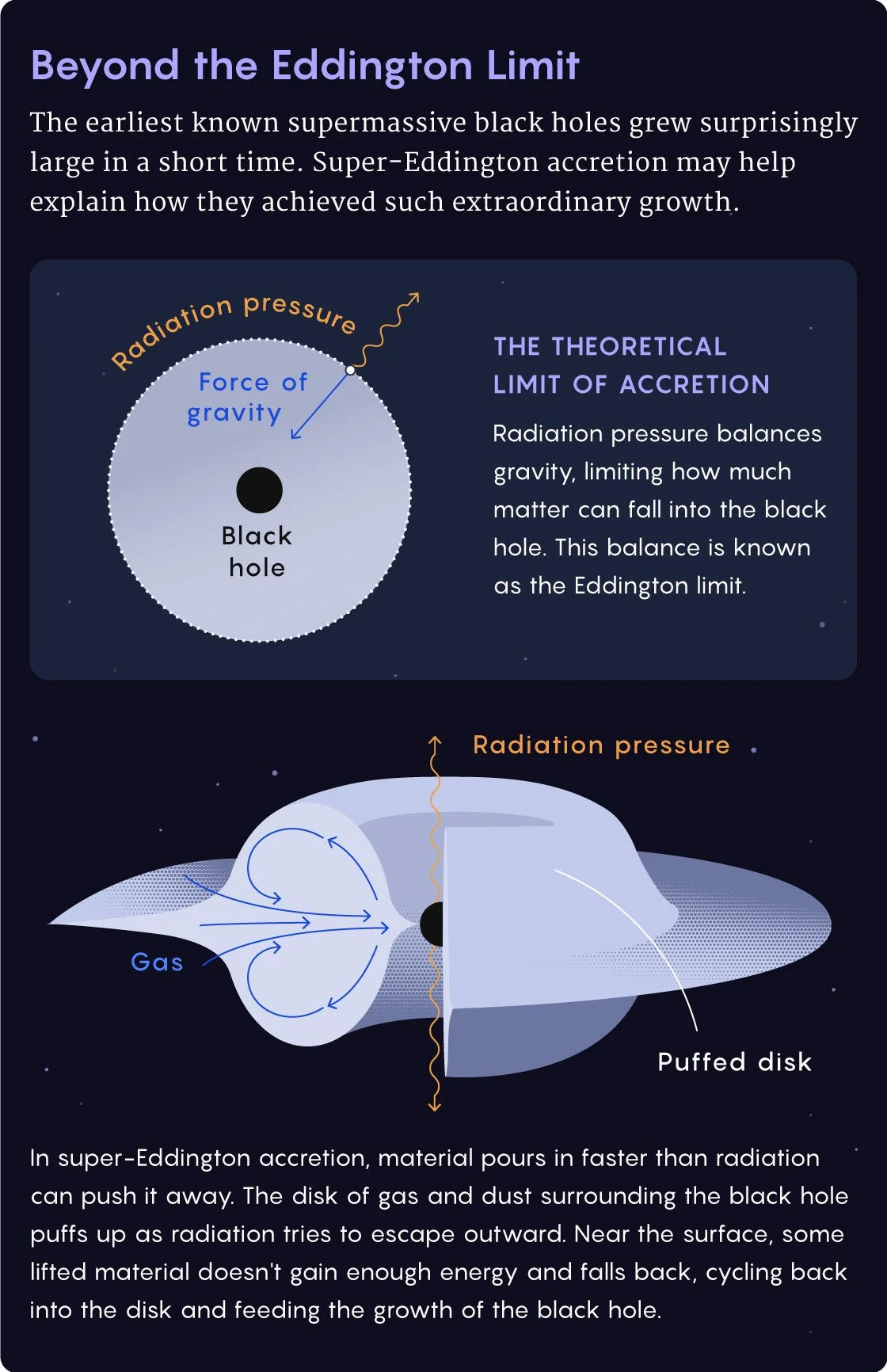
Physics imposes a "speed limit" on black hole growth known as the Eddington limit. As gas falls toward a black hole, it heats up and creates radiation pressure. This pressure acts like a gale-force wind, pushing incoming material away and halting the growth of the black hole.
However, recent computer simulations suggest a "back door." If an accretion disk—the ring of material swirling into the black hole—puffs up in a specific configuration, it can channel gas directly into the maw of the black hole, bypassing the radiation pressure. This "super-Eddington" accretion allows for rapid growth. Furthermore, some researchers propose the "direct collapse" mechanism, where gargantuan clouds of gas bypass the star-formation phase entirely, collapsing directly into a black hole seed 10,000 times the mass of the sun.

"The problem with the direct-collapse picture is that it requires really Goldilocks conditions," Greene notes. The gas must be perfectly still and chemically pure to avoid breaking into smaller star-forming clumps. While scientists can simulate these events, they struggle to produce enough of them to explain the sheer volume of early black holes detected by the JWST.
Analyzing the "Little Red Dots"
Charlotte Mason’s doodles represent a genuine scientific pivot. Her team recently analyzed the light spectrum of a little red dot, hoping to find evidence of a dense gas shroud. If the dots were simply black holes hidden behind gas clouds, the light should show specific distortions. Instead, the data didn’t match the expectation.
"Now what do I do? Start again," Mason says. She is now exploring models where the gas clouds are "clumpy," allowing light to escape through gaps. This iterative process is happening in laboratories worldwide, as the "naive" models of 2022 are systematically replaced by more complex, nuanced simulations.
Building a Galaxy: Diversity in the Void
The mystery of early galaxies is similarly profound. Using the JWST’s Mid-Infrared Instrument (MIRI), researchers like Hakim Atek of the Paris Institute of Astrophysics have discovered that early galaxies are remarkably diverse.
"The main surprise is the diversity of the properties of galaxies we are seeing at early epochs," Atek says. "You’re expecting that they would look the same."

Some galaxies appear to be "naked"—composed only of stars, with all gas and dust cleared away—while others are thick with gas and undergoing intense, sporadic bursts of star formation. The presence of excess nitrogen in some of these galaxies further suggests that they were populated by massive, short-lived stars that exploded as supernovae, seeding the cosmos with the heavy elements necessary for the later development of planets and life.
Implications for the Future of Cosmology
The ongoing work by researchers at institutions like the Flatiron Institute and the Cosmic Dawn Center is not just about cataloging stars; it is about refining the "how" of our existence.
As Rachel Somerville, a senior research scientist at the Flatiron Institute, noted at a recent conference in Denmark, the progress in numerical simulations has been "really remarkable." By comparing JWST observations to simulations that account for turbulent gas, star formation bursts, and dark matter distribution, scientists are finally beginning to see a coherent picture emerge.
The Human Connection
There is a poetic irony to this research. The conference in Denmark was held near the castle that inspired Shakespeare’s Hamlet. In the play, the prince laments the "quintessence of dust"—a mournful view of humanity. Yet, modern astrophysics has transformed that sentiment into a scientific fact. We are, quite literally, the result of the first stars that forged carbon, nitrogen, and oxygen before exploding into the void.
The "foul and pestilent congregation of vapors" described by Shakespeare is, in reality, the creative fire of the early universe. As the JWST continues to peer back toward the beginning of time, it is not just observing cold, dead objects; it is documenting the origin story of every atom in the human body.

We are still in the early days of this new era of discovery. Each photon that reaches the JWST’s sensors is a fragment of a puzzle that is still being assembled. While the theories are currently in flux, the consensus is clear: the early universe was a vibrant, active, and deeply surprising place—a testament to the fact that the more we learn about our cosmic beginnings, the more "human" the universe appears.
As Mason continues her sketches and the supercomputers crunch the data, one thing is certain: the "little red dots" and the "impossible" black holes are not errors in our telescopes. They are invitations to rewrite the history of everything.