In the pursuit of the "ultralight" ideal, the modern backcountry traveler faces a bewildering array of textile choices. The days when "nylon" or "polyester" served as sufficient descriptors for outdoor gear are long gone. Today, the industry is defined by high-performance composites like Dyneema Composite Fabric (DCF), Challenge UltraWeave, ECOPAK, and ALUULA. However, a common pitfall for both consumers and designers is the tendency to classify these materials strictly by their base fibers.
While material family—such as Dyneema, UHMWPE, or silnylon—is a useful starting point, it is rarely sufficient for specific product use cases. Two fabrics within the same family can exhibit vastly different mechanical properties regarding mass, tear strength, abrasion resistance, and dimensional stability. Choosing the right material requires an engineering-first perspective, acknowledging that the "best" fabric is not the strongest, but the one that optimizes the trade-offs inherent in a specific application: packs, shelters, or storage systems.
Main Facts: The Anatomy of Technical Laminates
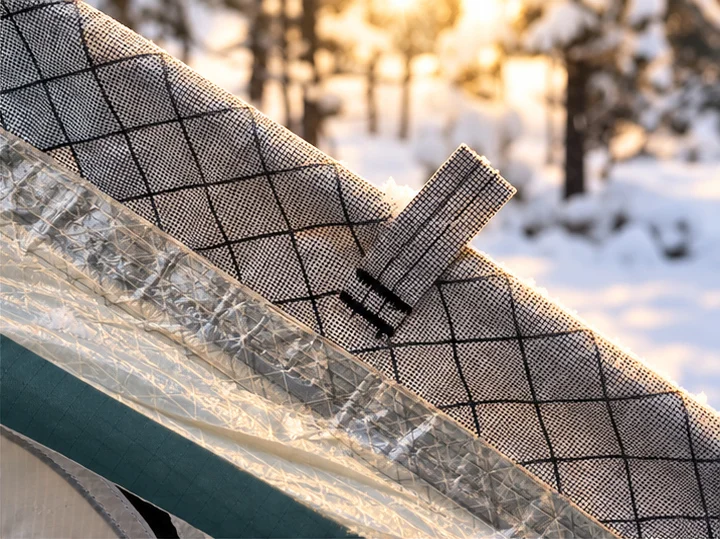
At its core, the technical fabric market has shifted from traditional monolithic woven fabrics toward sophisticated laminates. These structures typically combine a face fabric (for durability and aesthetics), a reinforcement layer (often an X-Ply or grid structure to manage bias stretch), and a waterproof film (for environmental protection).
The Rise of Composite Architectures
The primary driver of modern innovation is the need to decouple waterproofness from structural strength. Traditional silnylon achieves both through heavy coatings, but at the cost of "wet stretch" and moisture absorption. Conversely, composites like DCF use nonwoven fibers sandwiched between films, offering incredible strength-to-weight ratios. Challenge UltraWeave takes a different approach by utilizing a woven UHMWPE face to carry structural loads, while the film provides the necessary barrier.
The Measurement Challenge
A critical hurdle for the end-user is the lack of standardized testing. Published values for tear strength, abrasion, and hydrostatic head (HH) are only comparable when test methods are identical. Differences in specimen geometry, loading rates, and manufacturer protocols mean that a "20,000 mm" rating from one lab might not correlate with a similar rating from another. When evaluating data, one must prioritize manufacturers who provide ASTM-standardized testing rather than internal, non-verifiable protocols.
Chronology: The Evolution of Fabric Tech
The history of outdoor materials has moved through distinct eras of optimization:
- The Conventional Era: Dominated by uncoated or PU-coated nylons. These were durable and predictable but prone to water absorption and sagging.
- The Silicone Revolution: The introduction of silnylon and silpoly allowed for significantly lower weights. These fabrics became the industry standard for shelters for decades due to their flexibility and reliable performance.
- The Composite Emergence (The DCF Era): Dyneema Composite Fabric (formerly Cuben Fiber) revolutionized the ultralight movement. By eliminating the weave, designers achieved unprecedented low mass and high dimensional stability, essential for the "fast and light" ethos.
- The High-Modulus Woven Era: The recent introduction of Challenge UltraWeave and ECOPAK represents a maturation of the industry. By blending UHMWPE (Ultra-PE) into woven face fabrics, manufacturers have created materials that offer the durability of traditional nylon with the weight-to-strength advantages of aerospace-grade composites.
- The Welding Era: With the advent of ALUULA and similar thermoplastic composites, the industry is currently transitioning toward heat-weldable structures. This move reduces reliance on needle-and-thread construction, which historically represents the weakest point in any waterproof system.
Supporting Data: Application-Specific Requirements
To navigate the technical specifications, one must categorize materials by their mechanical demands.
Pack Fabrics: Resisting Sustained Loads
Pack fabrics are subjected to extreme, localized stress. A pack’s life is determined not by the average panel strength, but by its weakest seam or anchor point.
- Key Metrics: Stitch support, puncture resistance, and flex-fatigue.
- Top Performers: Ultra200X and Ultra400X have emerged as the gold standard for high-abrasion zones, while X-Pac VX21 remains a trusted, albeit heavier, workhorse for general-purpose durability.
Shelter Fabrics: Managing Tension and Environment
A shelter is a structural engineering project. The fabric must maintain its geometry while being buffeted by wind and subjected to UV radiation.
- Key Metrics: Dimensional stability (wet stretch), tear strength, and UV resistance.
- Comparative Insight: Silpoly remains superior to silnylon in wet conditions because it does not absorb moisture, preventing the "sagging" that often occurs overnight in damp weather. DCF offers the best weight-to-rigidity ratio but requires more care regarding puncture damage.
Storage Systems: Flex and Fold
Storage systems are unique because they are constantly cycled. The material’s ability to survive repeated folding, rolling, and zipper tension is more important than its raw tensile strength.
- Key Metrics: Flex durability and coating adhesion.
- Top Performers: DCF 1.6 and various ECOPAK EPLX constructions are preferred for their balance of weight and waterproofness, though one must be mindful that thin films can crack under repeated, sharp-crease folding.
Official Responses and Industry Perspectives
Leading manufacturers, including Challenge Outdoor and the suppliers of Dyneema, emphasize that "headline" specs—the numbers highlighted on marketing brochures—are often misleading. In recent white papers, Challenge Outdoor has clarified that their UltraWeave specifications are highly dependent on the specific face-denier used.
Furthermore, the shift toward "C0" (fluorine-free) DWR treatments in the ECOPAK line represents a broader industry response to environmental regulations. While these treatments are more sustainable, they require different care routines from the user. The industry consensus is clear: the era of "one-size-fits-all" fabric is over. Designers are now moving toward "zonal construction," where a pack might use a robust 400D face fabric on the bottom panel for abrasion resistance, and a much lighter 100D or film-laminate on the body to save weight.
Implications: A Practical Selection Framework
How does an enthusiast or designer choose? The following framework simplifies the decision-making process:
- Define the Load Type: Is the item structural (a pack frame), environmental (a shelter), or containment (a stuff sack)?
- Determine the Failure Mode: Is the primary risk puncture (rocks/sticks), abrasion (the trail/friction), or fatigue (repeated folding)?
- Evaluate Construction Compatibility: Can you sew the material, or does it require specialized seam tape or heat welding? Using a fabric that is "easy to sew" (like ROBIC nylon) may result in a more durable finished product than using a high-tech laminate that is poorly executed.
- Analyze the Margin: Never aim for the "thinnest possible" fabric. Always look for the lightest material that provides a 20-30% safety margin over the expected stress at the most critical failure point (e.g., shoulder strap attachments).
The Future of Fabric Selection
As we move forward, the "holy grail" remains a material that is both light and abrasion-resistant, while also being easily field-repairable. We are seeing a slow transition away from needle-and-thread towards fusion-bonded seams, which eliminate the need for seam sealing and reduce weight.
However, the "best" gear remains a result of deliberate design choices. An UltraWeave pack is not "better" than a ROBIC pack; it is simply better suited to a specific set of requirements. The user must be willing to accept that every material has a limit. By understanding the interaction between fibers, films, and construction methods, we can make informed decisions that extend the life of our gear and enhance our experience in the backcountry.
For those looking to deepen their expertise, further reading is recommended in the technical white papers provided by fabric manufacturers like Challenge Outdoor and the archival research available through specialized forums and educational platforms such as Backpacking Light. Whether you are an MYOG (Make Your Own Gear) enthusiast or a discerning consumer, viewing fabrics through an engineering lens is the only way to cut through the marketing noise and find the true performance you need.