Deep within the heart of central Norway lies a landscape that defies simple description. The Trollheimen Mountains, a sprawling, jagged expanse of transitionary geology, serve as a bridge between the raw, maritime climate of the coast and the high-altitude, unforgiving environment of the interior. It is a place of ancient woodlands, crystalline lakes, and dramatic ridgelines—a region where the name itself, "Home of the Trolls," feels less like a marketing gimmick and more like an acknowledgement of the region’s brooding, mythological presence.

While the "Trollheimen Triangle" remains a staple among the Norwegian outdoor community, it is arguably one of the most underrated long-distance trekking circuits in Europe. For the international hiker, it offers a distilled version of Scandinavia’s wild heart: accessible yet challenging, steeped in history, and utterly devoid of the commercialized overcrowding found in more famous Alpine regions.

Main Facts: The Anatomy of the Triangle
The Trollheimen Triangle is a 58-kilometer (36-mile) circuit that invites hikers to step back in time. The route is defined by its architectural and historical markers, ranging from Stone Age settlement sites to Iron Age burial mounds and the iconic, turf-roofed farmhouses that have defined Norwegian rural aesthetics for centuries.

- Distance: 58 km (36 mi)
- Duration: 2–3 days (depending on pace and weather conditions)
- Difficulty: Moderate
- Total Elevation Gain: 2,720 m (8,924 ft)
- Start/Finish: Gjevilvasshytta mountain hut
- Best Season: Mid-July through mid-September
The moniker "Trollheimen" was officially adopted in the late 19th century, specifically crafted to stimulate tourism. While it may have had middling international results in the Victorian era, modern hikers are rediscovering the region as a sanctuary of solitude. The route is serviced by a network of high-quality mountain huts—managed by the Norwegian Trekking Association (DNT)—that provide both shelter and a window into the traditional mountain lifestyle.

Chronology of the Route
The journey typically commences at the historic Gjevilvasshytta, a mountain lodge dating back to 1819. The route is traditionally completed in a counter-clockwise direction to maximize the interplay between valley terrain and elevated mountain passes.

Phase One: The Gateway to the High Fells (21 km)
Departing from Gjevilvasshytta, the trail immediately asserts its character. The first five kilometers serve as a gentle ascent through the lush birch forests of the Gjevilvassdalen Valley. As the tree line recedes, the landscape opens into a vast, rolling tundra. The path winds beneath the imposing Høghøa Peak (1,308 m), guiding hikers into the marshy, lake-speckled Høghødalen Valley.

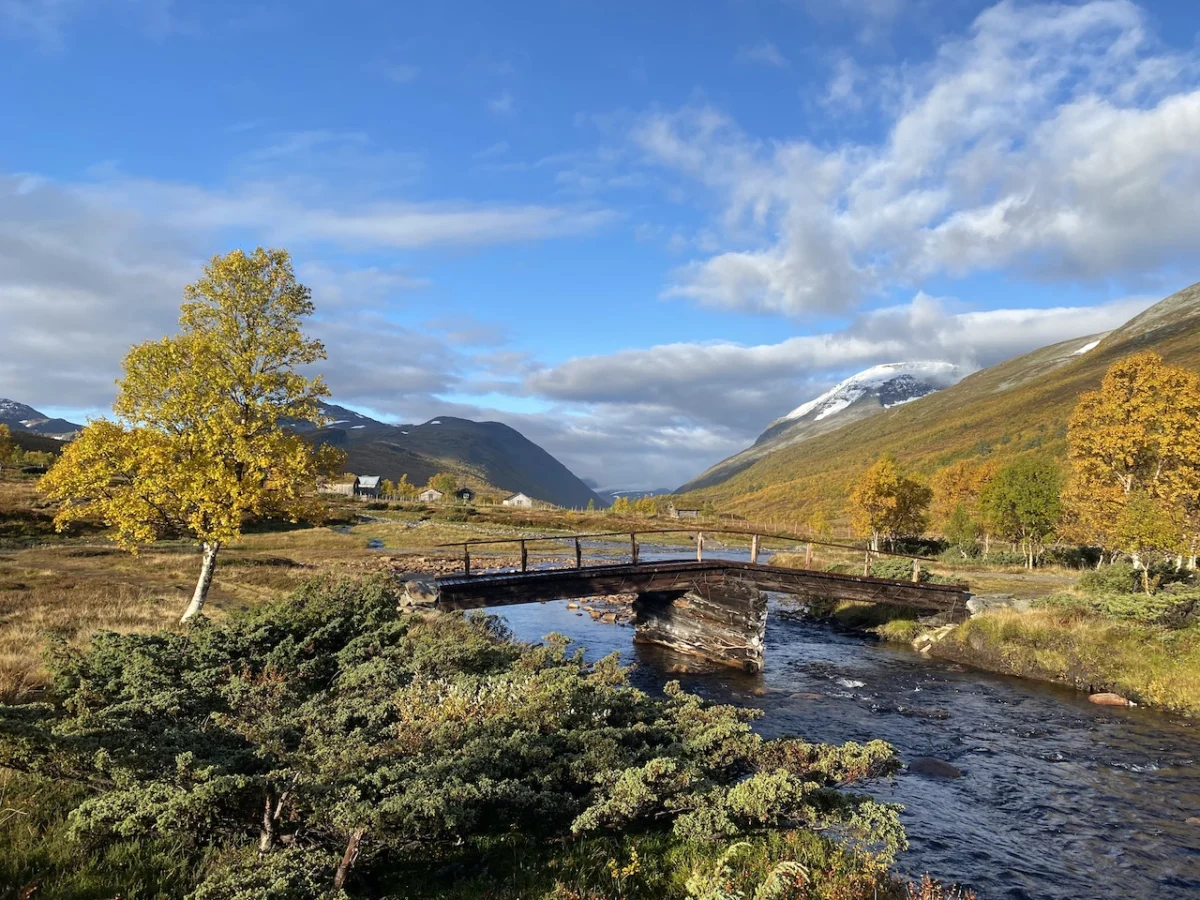
At the 11-kilometer mark, the crossing of the Minnilla River via footbridge acts as a psychological waypoint. From here, the trail rises over undulating fells toward the shadow of Skrikhøa Peak (1,061 m). The descent into the Gammelsæterdalen Valley is long and gradual, providing a panoramic introduction to the Jøldalshytta hut, which sits majestically overlooking the dark, reflective waters of Jølvatnet Lake.

Phase Two: Choosing the Path (16 km)
The second stage, leading to the remote Trollheimshytta, presents the hiker with a strategic decision. If the weather holds, the high-altitude traverses over Geithøtta (1,316 m) or the formidable Trollhetta (1,616 m) are the preferred routes for those seeking elevation and exposure. However, in the fickle climate of central Norway, the low-level option—tracing the course of the Svartåa River—is a masterpiece of riparian beauty. This path winds through verdant meadows and past clusters of traditional turf-roofed cottages, offering a more intimate look at the flora of the valley floor.

Phase Three: The Crucible (21 km)
The final leg is the most demanding, testing the endurance of even experienced trekkers. From Trollheimshytta, the path crosses the Slettåa River and begins a punishing, zigzagging ascent through rocky terraces. Hikers gain roughly 700 meters of elevation in less than three kilometers. Topping out at Skallen Peak (1,226 m) is the ultimate test. On a clear day, the vista encompasses the entire Svartåmoen Nature Reserve. In poor conditions, however, the plateau becomes a lesson in resilience—a place where the wind and rain demand complete focus. The route then continues across the tarn-peppered plateau of Mellomfjellet before descending past Fossådalsvatnet Lake and navigating the Riarskaret Pass (1,307 m).

Supporting Data and Logistical Insights
Successful completion of the Trollheimen Triangle requires more than physical stamina; it requires an appreciation for the logistics of the DNT system.

- Accommodation: The huts (Gjevilvasshytta, Jøldalshytta, and Trollheimshytta) offer a range of amenities from dormitories to private rooms. Many are "self-service" or "staffed" depending on the season. It is critical to check the DNT website for seasonal closures, as these high-country huts can become inaccessible or unstaffed by late autumn.
- Navigation: While the trails are well-marked with the iconic red "T" symbol, the unpredictable weather means that GPS and physical maps are non-negotiable. The transition zones in Trollheimen can experience "whiteout" conditions even in summer.
- The "Troll" Factor: The region is sensitive to erosion. Hikers are strictly advised to remain on marked paths. The fragile alpine vegetation, once damaged, can take decades to recover.
Official Responses and Conservation Efforts
The Norwegian environmental authorities and the Norwegian Trekking Association (DNT) have implemented rigorous standards to preserve the integrity of the Trollheimen region. Because the area is a transition zone between coastal and inland climates, the ecosystem is exceptionally diverse.

Conservationists point to the importance of the Svartåmoen Nature Reserve as a critical habitat. Management plans emphasize "Leave No Trace" principles, and the development of the mountain hut network is designed to centralize human impact, keeping foot traffic confined to established corridors. Officials warn that as climate change alters the growth patterns of birch forests and the stability of permafrost in the high passes, the maintenance of these trails becomes increasingly complex.

Implications for the Modern Trekker
What does the Trollheimen Triangle signify in the broader context of modern adventure travel?

First, it highlights the growing desire for "authentic" experiences over "Instagrammable" ones. In an age of over-touristed national parks, the Trollheimen offers a return to the roots of mountaineering: self-reliance, quiet observation, and a deep, visceral connection to a landscape that refuses to cater to the comfort of the visitor.

Second, it serves as a masterclass in risk management. The hiker who traverses the high passes of the Triangle learns quickly that the mountain dictates the schedule. The decision to opt for a valley walk during a storm is not a failure; it is an intelligent adaptation to the environment.

Finally, the Trollheimen serves as a repository of human history. By walking from hut to hut, one is not just traversing a mountain range; one is retracing the steps of shepherds, farmers, and travelers who have utilized these paths for millennia. The turf-roofed cottages and the ancient burial sites are not just scenery—they are reminders that this landscape has been a home, a workplace, and a spiritual touchstone for generations.

Whether you are seeking the challenge of the high summits or the meditative rhythm of the valley floor, the Trollheimen Triangle offers a profound, lingering experience. It is a place that strips away the noise of the modern world, leaving you with nothing but the wind, the stone, and the distant, imagined sound of trolls in the mist.