In the world of high-performance climbing, gear is rarely synonymous with "all-day comfort." The pursuit of technical excellence usually demands a trade-off: aggressive downturns, asymmetric shapes, and stiff soles that, while powerful, often leave a climber’s feet begging for relief after a single pitch. Enter the La Sportiva Skwama. Over the last decade, this model has achieved a near-mythical status, bridging the gap between the ruthless precision required for elite bouldering and the nuanced sensitivity needed for technical granite smearing.
The Skwama’s rise to prominence is not merely a marketing success; it is a testament to engineering that favors adaptability. For those who have followed the career of legendary climber Babsi Zangerl, the sight of these shoes on the granite faces of El Capitan is iconic. But does the shoe live up to the hype? After seven years of rigorous testing across the limestone of Europe, the volcanic tuff of the American West, and the classic granite of the High Sierra, the answer is a resounding yes.
Main Facts: The Anatomy of a High-Performance Slipper
The La Sportiva Skwama ($220) is defined by its ability to blend the sensitivity of a soft, slipper-like construction with the power of an aggressive, downturned shoe. Unlike rigid, lace-up models designed strictly for micro-edges, the Skwama utilizes a split-sole design and high-friction rubber to provide unparalleled tactile feedback.

Core Technical Specifications:
- Construction: Unlined leather upper for a glove-like fit.
- Rubber: 4mm Vibram XS Grip2, known for its superior friction and grip.
- Profile: Aggressively downturned with medium asymmetry.
- Closure: Single-strap Velcro for rapid adjustment.
- Key Tech: S-Heel construction for precise hooking; P3 (Permanent Power Platform) randing to maintain the shoe’s shape over time.
The genius of the Skwama lies in its versatility. It is one of the few shoes on the market that feels equally at home in a high-intensity gym bouldering session as it does on a multi-pitch trad route. By utilizing the P3 system, La Sportiva ensures that even as the leather stretches and the sole softens, the shoe retains its aggressive tension, allowing it to perform well beyond its initial break-in period.
A Decade of Dominance: The Chronology of a Favorite
The evolution of the Skwama began as a challenge to the industry standard: create a shoe that wouldn’t sacrifice the "feeling" of the rock for the sake of power. In the climbing world, 10 years is an eternity for a piece of equipment to remain at the top of the "best-of" lists.
- The Early Years (2015-2017): Initially adopted by elite boulderers, the Skwama was praised for its toe-patch rubber, which revolutionized how climbers approached overhanging, roof-heavy terrain.
- The Mid-Life Transition (2018-2021): As more alpine and traditional climbers saw pros like Zangerl wearing the shoe, the Skwama migrated from the bouldering mats to the big walls. It proved that "soft" didn’t have to mean "ineffective" on long, multi-pitch granite faces.
- The Modern Standard (2022-Present): Today, the Skwama is widely considered the gold standard for "all-around" performance. It has survived the trend of increasingly stiffer shoes by proving that the human foot, when given proper sensitivity, can outperform a stiff sole on almost any angle.
Performance Analysis: Where the Skwama Excels
To understand the Skwama, one must understand the terrain it conquers.

The Art of the Smear
Because of its split-sole design and the properties of the Vibram XS Grip2 rubber, the Skwama allows the foot to deform over irregular rock surfaces. This makes it a weapon on granite slabs where friction is the only thing keeping the climber on the wall. While many performance shoes are too rigid to "spread" their contact patch, the Skwama conforms to the microscopic texture of the stone.
Steep Terrain and Toe-Hooking
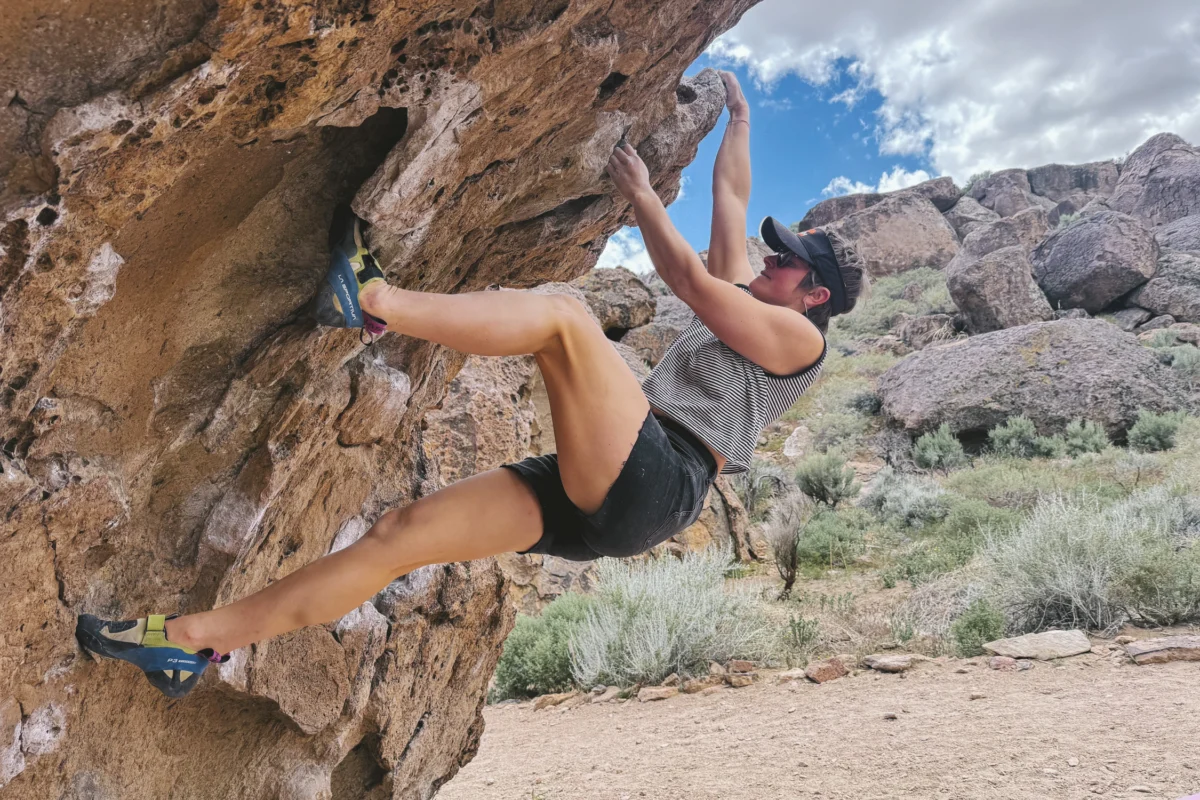
The shoe’s most famous feature is its aggressive downturn combined with a generous, high-friction toe patch. On overhanging limestone, where "toe-in" power is essential, the Skwama provides a solid platform to pull your body into the wall. The rubber wrapping around the forefoot allows for secure jamming and hooking, which is often a point of failure for less specialized footwear.
The Trade-off: Edging Limitations
It is important to be transparent about the Skwama’s limitations. If your primary objective is climbing vertical, technical limestone where the footholds are razor-thin, glass-like edges, the Skwama will feel inadequate. Its soft construction means that on tiny, credit-card-sized edges, your calf muscles will do significantly more work than they would in a stiffer, more supportive model. For sustained technical edging, a shoe with a full-length stiff midsole is superior.

Supporting Data: Why "Unicorn" Status Matters
In the gear industry, the "unicorn" label is reserved for products that defy their category. Typically, a climbing shoe is categorized as either:
- Stiff/Supportive: Great for edging, bad for smearing/comfort.
- Soft/Sensitive: Great for smearing/indoor bouldering, bad for long-duration support.
The Skwama occupies the narrow middle ground. Data from user feedback and long-term testing indicates that while the shoe is soft, the inclusion of the P3 randing prevents the "slipper" sensation from becoming a "sock" sensation. It keeps the pressure focused on the big toe, even when the shoe has been broken in for months.
Furthermore, the price-to-performance ratio is a significant factor in its popularity. At $220, it sits at the high end of the market, yet it outperforms many shoes that are significantly more expensive or require frequent, costly resoles due to poor construction.

Official Manufacturer Perspective: The Design Philosophy
La Sportiva has historically maintained that the Skwama was designed for the "modern climber." In their internal design briefs, the company emphasizes the importance of "fluidity." The idea was to move away from the traditional, rigid architecture of the 1990s and toward a construction that mimics the anatomy of the foot.
The S-Heel, in particular, was a proprietary development aimed at solving the "bulky heel" problem. By creating a heel cup that is stable but also capable of torsion, La Sportiva allowed climbers to hook, twist, and pull without the heel popping off or feeling like it was slipping. While some critics argue the S-Heel is still too voluminous, La Sportiva stands by the design as the best balance of comfort and security for the widest range of foot shapes.
Implications for Your Next Purchase
If you are in the market for a new pair of climbing shoes, the decision to buy the Skwama should be based on your specific climbing goals.

Who Should Buy It?
- The Versatile Climber: If you climb a mix of gym boulders, sport routes, and the occasional trad pitch, this is the most capable shoe you can buy.
- The Comfort-Conscious Athlete: If you hate the feeling of your feet being crushed in a "vise-grip" style shoe but still want high-level performance, the Skwama is your best bet.
- The Steep-Terrain Enthusiast: If you spend your time in caves or on overhanging rock, the technical toe-patch is a game-changer.
Who Should Avoid It?
- The Pure Edger: If you spend your weekends on granite crystals or thin limestone edges, you will likely find the Skwama too "mushy." Look for a stiffer model like the La Sportiva Miura or the Scarpa Boostic.
- The Precision-Heel Purist: If you have a very narrow heel or find that you require a more sensitive, thin-profile heel for complex hook-and-scum maneuvers, you may prefer the Scarpa Instinct VSR.
Sizing Advice
Because the Skwama is unlined leather, it will stretch. A common mistake is buying it too large. For a high-performance fit, most climbers size down 1 to 2 sizes from their street shoe. However, if you intend to use them for long, multi-pitch days, you may want to stay closer to your actual size to allow for the natural swelling of the feet.
Conclusion: The Final Verdict
The La Sportiva Skwama has earned its place in the climbing hall of fame. It is a rare piece of equipment that manages to be both a tool of precision and a comfortable companion for long days at the crag. While it may not be the "end-all-be-all" for every single style of climbing—specifically those requiring rigid edging—it offers a level of versatility that is nearly unmatched in the current market.
Whether you are inspired by the legendary exploits of climbers like Babsi Zangerl or you are simply looking for a reliable, high-performance shoe to carry you through the next season, the Skwama is a benchmark of quality. It is, quite simply, the unicorn of the climbing world: a shoe that does almost everything, and does it exceptionally well.