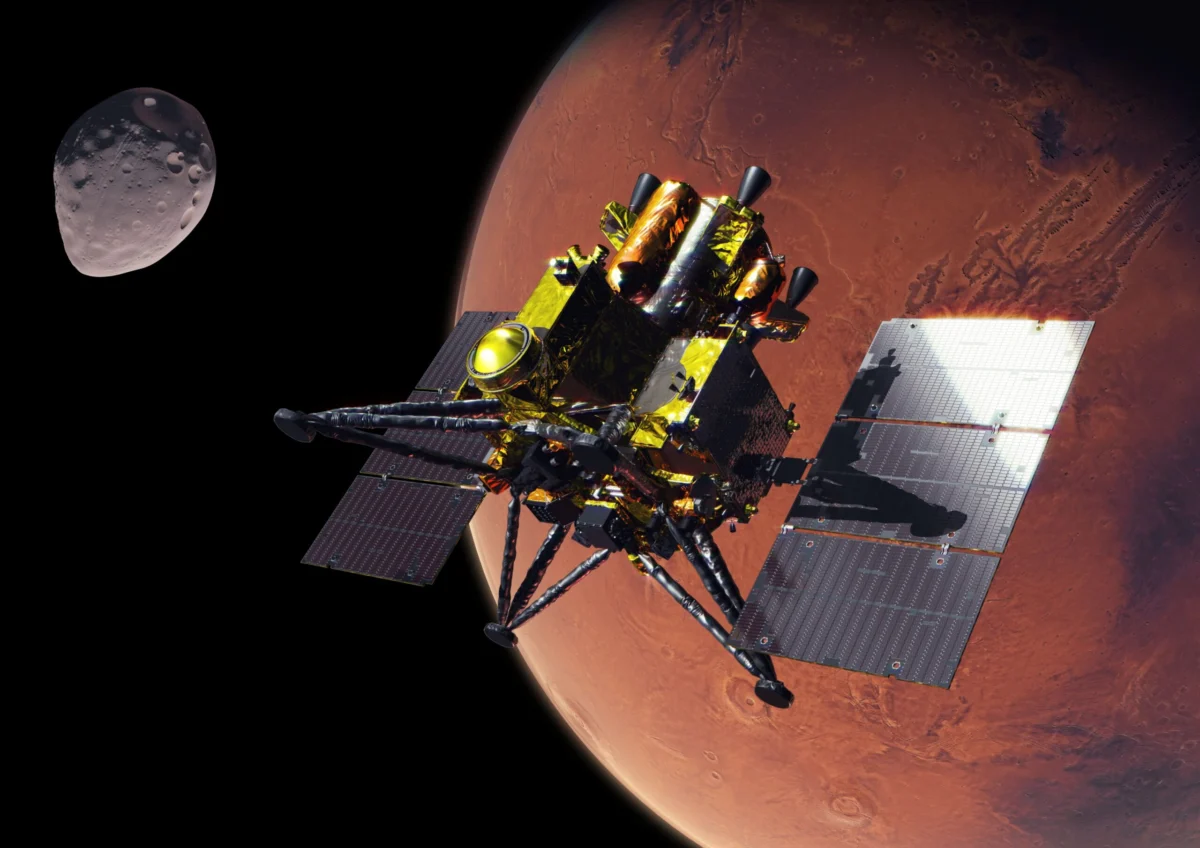
In the annals of space exploration, few celestial bodies have remained as enigmatic as the moons of Mars. While humanity has spent decades scrutinizing the surface of the Red Planet, its two diminutive companions—Phobos and Deimos—have largely remained distant observers. That is set to change with the Japan Aerospace Exploration Agency’s (JAXA) "Martian Moons eXploration" (MMX) mission. By aiming to return the first-ever physical samples from a Martian moon, JAXA is poised to settle a long-standing cosmic debate: are these moons captured asteroids, or the shattered remnants of Mars itself?
The Core Objective: Solving a Solar System Mystery
The MMX mission is defined by its scientific ambition. The probe is tasked with touching down on Phobos, the larger and closer of Mars’ two moons, to collect at least 10 grams of regolith. While 10 grams may seem modest, it represents a treasure trove for planetary geologists.
The central scientific question driving the mission is the origin of the Martian moons. Scientists currently favor two primary hypotheses. The first, the "Giant Impact" hypothesis, suggests that a massive collision between Mars and a large protoplanet billions of years ago ejected a plume of debris into orbit, which eventually coalesced into Phobos and Deimos. The second theory proposes that the moons are captured asteroids from the outer solar system, drawn in by Mars’ gravity over eons.
Evidence currently exists for both sides. The moons’ dark, carbon-rich surfaces resemble primitive asteroids found in the outer solar system. Conversely, their nearly circular, equatorial orbits are highly characteristic of bodies formed in situ from a debris disk rather than objects captured by chance. By analyzing the isotopic composition of the Phobos samples, scientists expect to definitively determine the moon’s provenance. If the rocks contain minerals that match the chemical signature of Mars, the impact hypothesis will be effectively proven.
A Decadal Chronology: From Launch to Return
The journey of MMX is a testament to the patience required for deep-space exploration. The mission is a multi-year commitment that pushes the boundaries of orbital mechanics.
- October 20, 2026: Launch is scheduled from the Tanegashima Space Center. The spacecraft will begin its long transit through the inner solar system.
- 2027: The MMX probe reaches the Mars system.
- 2027–2030: A three-year operational phase commences. The probe will conduct a comprehensive survey of both Phobos and Deimos, utilizing a suite of scientific instruments to map the surface and monitor the environment.
- 2030: The return phase begins. The probe will depart the Mars system, carrying its precious cargo back toward Earth.
- 2031: If the mission proceeds according to the flight plan, the return capsule will re-enter Earth’s atmosphere, delivering the samples for laboratory analysis.
Engineering the Impossible: Technical Hurdles
The MMX mission is a feat of engineering, particularly regarding its landing and sampling mechanisms. With a mass of 4,480 kilograms at launch, the probe is a heavy-lifter. However, more than half of that weight is comprised of fuel, necessitated by the rigorous demands of the outbound, exploration, and return legs.
The Landing Paradox
Landing on Phobos is a unique challenge. With a radius of only 11 kilometers, Phobos has a gravity so weak that traditional landing maneuvers designed for larger bodies—or even the asteroid Ryugu—are insufficient. On Ryugu, JAXA successfully utilized a "hover and touch" method, but Phobos’ gravity is roughly 50 times stronger than the asteroid’s. Hovering for extended periods would consume prohibitive amounts of fuel.
To solve this, JAXA has integrated high-precision autonomous navigation. Because the distance between Earth and Mars results in a communication latency of up to 20 minutes, the probe cannot be piloted in real-time. It must possess "eyes" and "brains" to navigate the treacherous, crater-pocked terrain.
The Role of IDEFIX
Before the main probe attempts its landing, it will deploy the IDEFIX rover. Developed through a collaboration between the French space agency (CNES) and the German Aerospace Center (DLR), IDEFIX is a sophisticated scout. It will spend approximately 100 days traversing the Phobos surface, analyzing the local environment and providing high-resolution data on soil composition and stability. This preliminary survey is critical for identifying a landing site that minimizes risk to the main spacecraft.
The Sampling Mechanism
Once the main probe has successfully landed, it will deploy a dual-method collection system. A robotic arm will use a drill to extract core samples from beneath the surface, while a NASA-provided pneumatic system will blast the surface with nitrogen gas to collect fine-grained dust. Notably, scientists expect that up to 0.1 percent of these collected samples may actually be debris from the Martian surface itself, kicked up by eons of meteorite impacts, effectively providing a "free" sample of the Red Planet.
Implications for Future Space Exploration
The MMX mission is more than a search for geological history; it is a proving ground for the technologies that will define the next century of space travel. With a budget of approximately $345 million USD, the mission represents a significant investment by Japan, marking its most ambitious Mars-related undertaking in nearly three decades.
Advancing Autonomous Systems
The success of MMX hinges on its autonomous landing sequence. By comparing real-time topography data against pre-loaded crater maps, the probe will be able to detect hazardous terrain and adjust its descent trajectory on the fly. This level of autonomy is essential for future missions to the outer solar system, where signal delays make human-in-the-loop navigation impossible.
Refining Round-Trip Dynamics
Perhaps the most significant engineering implication is the mission’s design as a round-trip voyage. Bringing samples back from a moon of Mars is the closest analog we have to a human crewed mission to the Martian surface. By testing the jettisoning of modules—shedding mass as fuel reserves are depleted—MMX provides a blueprint for the logistics required to return humans safely to Earth from another planet.
Official Perspectives and Scientific Consensus
Dr. Tomohiro Usui, a leading researcher at JAXA, has frequently noted that MMX is a "bridge" between lunar exploration and deep-space planetary science. The global scientific community, including partners at NASA, ESA, and the German and French space agencies, views this mission as a vital piece of the puzzle regarding the evolution of terrestrial planets.
"Understanding the moons is not just about the moons themselves," says one planetary scientist involved in the mission. "It is about understanding the environment of Mars at the time these moons were formed. If they are captured asteroids, they tell us about the migration of objects in the early solar system. If they are the result of an impact, they tell us about the cataclysmic events that shaped the Martian surface."
Conclusion: A New Era for JAXA
As the October 2026 launch date approaches, the excitement surrounding the MMX mission continues to grow. It is a mission of "firsts": the first sample return from a Martian moon, the first rover deployment on Phobos, and a milestone for Japan’s resurgence in deep-space exploration.
By the time the samples arrive in 2031, they will not only provide answers to the origins of the Martian system but will also serve as a monument to international cooperation and technological ingenuity. In the quiet, dark space around Mars, a small Japanese probe will soon be doing the heavy lifting to reveal the secrets of our celestial neighbor, proving that even the smallest moons can hold the keys to understanding the history of our solar system.