Wireless charging has evolved from a futuristic gimmick into a household utility. While the market is currently dominated by high-performance, minimalist pucks and sophisticated multi-device stations, a vast secondary ecosystem exists. These devices often target specific aesthetics, niche use cases, or specialized lifestyle needs that mainstream chargers simply don’t address.
After rigorous testing of over 100 wireless charging solutions, we have identified a curated list of devices that, while perhaps not earning the top spot in our primary "Best of" guide, offer unique value propositions worth considering. Whether you are looking to integrate charging into your furniture or seeking the fastest proprietary speeds, this analysis explores the nuances of the current wireless landscape.
Main Facts: The State of Wireless Charging
The wireless charging market is currently defined by the transition from the legacy Qi standard to the more efficient, magnetic-alignment-focused Qi2 standard. This shift brings the convenience of Apple’s MagSafe ecosystem to a wider range of devices, including the latest Android flagships.
However, the "best" charger is often subjective. For some, the priority is pure speed; for others, it is the integration of the charger into a home’s interior design. Our testing reveals that efficiency, thermal management, and build quality remain the three pillars of a high-quality wireless charging experience. Regardless of the bells and whistles, the fundamental physics remains constant: wireless power transfer is less efficient than wired charging, resulting in thermal byproduct that users must account for, especially when using high-wattage fast chargers.
Chronology of Innovation: From Coils to Qi2
The history of commercial wireless charging has been a steady march toward higher efficiency and better user experience.
- The Early Years (2010–2015): Dominated by the original Qi standard, these chargers were often "blind," requiring precise placement that led to many "did it charge overnight?" frustrations.
- The MagSafe Revolution (2020): Apple introduced magnets to align coils perfectly, effectively solving the placement issue and increasing energy transfer efficiency.
- The Rise of Qi2 (2023–Present): Built upon Apple’s MagSafe technology, the Qi2 standard has standardized magnetic alignment for the broader smartphone industry, enabling faster, more reliable charging for both iOS and Android users.
Curated Alternatives: Performance and Design
While the primary contenders in our main guide offer the best overall balance, the following devices cater to specific, sometimes eccentric, needs.
1. The Krafted Couch Charger ($52)
Designed for the ultimate "lounging" setup, this charger is intended to drape over the arm of a sofa. While the concept is brilliant for those who hate tethering themselves to a wall, our testing found that its physical design has flaws. On velvet or smooth fabric, the ridges fail to provide sufficient grip, causing the unit to slip. However, its 6.6-foot cable and Qi2 rating make it a functional, if aesthetically polarizing, solution if you have a high-friction fabric couch.

2. Nimble Apollo Wireless Pad ($19)
For the eco-conscious consumer, the Nimble Apollo is a standout. Constructed from recycled silicone and post-consumer plastic, this pad prioritizes sustainability without abandoning core functionality. The silicone surface provides excellent grip, though it acts as a magnet for dust. Its magnetic alignment is sufficient for iPhone 12 and newer models, providing an affordable entry point into magnetic charging.
3. Einova Eggtronic Charging Stone ($70)
This is arguably the most "design-first" charger on the market. Carved from solid marble or stone, it is a masterclass in home decor integration. It features zero LEDs, making it ideal for bedroom use. However, the hard surface risks scuffing your phone if it lacks a case. It is a stylistic statement that proves that utility and luxury can coexist, provided you are willing to hide the power cable carefully.
4. Baseus Nomos 5-in-1 Charging Station ($88)
A powerhouse for the power-user, the Nomos is essentially a desktop hub. Featuring a tilting charging pad, a retractable USB-C cable, and a suite of additional ports (three USB-C and one USB-A), it is designed to manage an entire workstation’s worth of peripherals. It is the pragmatic choice for those who value multi-functionality over slim profiles.
5. Rapport London Formula Charging Tray ($475)
At a price point that can only be described as "obscene," the Rapport London tray is a luxury item. It offers a premium, lacquered-box aesthetic with a soft-touch interior for your watches and phone. While it performs its core duty—recharging devices without overheating—it is clearly aimed at a demographic that views charging equipment as an extension of high-end furniture rather than a utility.
6. iOttie iOS Wireless Duo ($80)
A reliable dual-charging solution that balances price and performance. Its fabric-wrapped stand is aesthetically pleasing, though the front-facing LED can be distractingly bright in a dark room. It provides a solid 15W for Pixels and 7.5W for iPhones, making it a dependable, if slightly bright, nightstand companion.
7. Journey Alti Play Performance Desk Mat ($120)
Merging a workspace mat with a charging station, the Alti Play features a Qi2 magnetic puck and a 5W area for earbuds. The inclusion of customizable RGB lighting makes it a clear choice for the gaming community. While the Lycra surface is functional, users who prefer a more premium tactile feel might find the material choice underwhelming.
8. Zens Liberty Wireless Charger (Glass Edition) ($150)
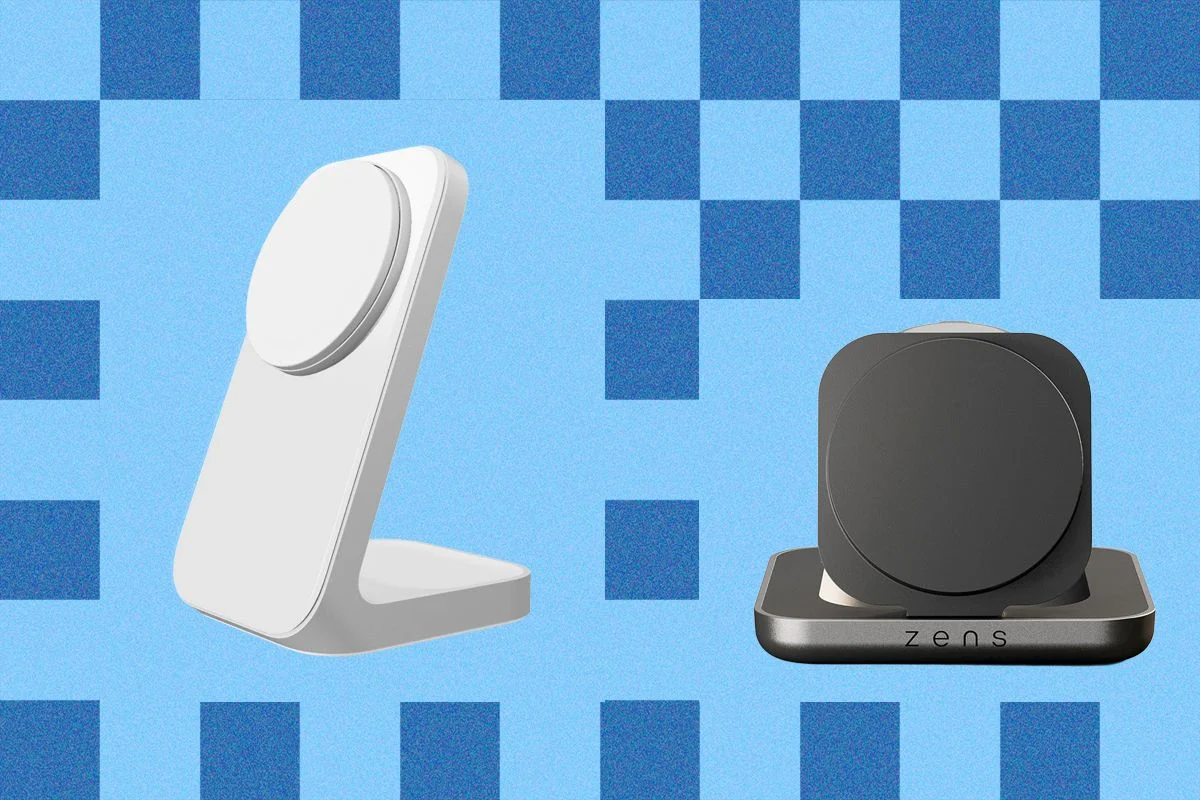
The Zens Liberty is a technical marvel. By exposing its 16 overlapping copper coils under glass, it removes all guesswork regarding phone placement. It is stunning, but it is also bulky, and the cooling fan—necessary for its high-wattage output—is occasionally audible.

9. Courant Catch:2 Essentials ($75)
The epitome of "understated luxury," the linen-wrapped Catch:2 is designed to sit in an entryway or living room. It is a dual-device charger that prioritizes texture and color coordination. It requires slightly more care in placement than a magnetic charger, but its aesthetic appeal is unmatched in this price tier.
10. Xiaomi Mi 80W Wireless Charging Stand ($80)
This is the speed king. It is significantly faster than any other charger we have tested, though this performance is almost exclusively limited to specific Xiaomi hardware. Its sail-like design is unconventional, and the cooling fan is quite active, but for those with a high-end Xiaomi device, it is the only way to achieve rapid, cordless refueling.
Supporting Data: Efficiency and Safety
Wireless charging efficiency is inherently lower than wired alternatives. While wired charging typically operates at 85 to 95 percent efficiency, Qi2 wireless chargers hover around 75 to 80 percent. The energy loss is converted into heat.
- Battery Health: Contrary to popular myths, wireless charging does not "kill" a battery faster than wired charging, provided the phone is managed correctly. Modern smartphones include thermal throttling and charge-management protocols that prevent overcharging or heat damage.
- The 50–80% Rule: To maximize the lifespan of your lithium-ion battery, it is recommended to keep the charge between 50 and 80 percent. Frequent, short-burst charging is generally better for the chemical longevity of the battery than deep discharge cycles.
Implications for the Future
The industry is clearly moving toward a more unified, magnetic future. As Qi2 adoption grows, we expect to see fewer "blind" pads and more chargers that treat magnetic alignment as the baseline standard.
Furthermore, the rise of "Qi2 Ready" devices—which have the internal hardware for magnetic charging but lack the actual magnets—indicates that manufacturers are pushing for a modular ecosystem. Users will soon be able to customize their phone’s charging capabilities simply by switching to a magnetic case, a trend that democratizes the benefits of MagSafe-style charging across the entire Android landscape.
Conclusion: Which Niche Should You Choose?
The best wireless charger is one that fits seamlessly into your life. If you are a minimalist, the Einova Stone or Courant Catch:2 offers beauty. If you are a power-user, the Baseus Nomos or Xiaomi 80W stand provides the throughput you need. For those on a budget or concerned about the environment, the Nimble Apollo serves as a reminder that effective charging does not have to be expensive or environmentally taxing.
While the market is flooded with options, focusing on your specific environment—whether it be a bedside table, a professional desk, or a casual living room—will lead you to the right choice. Remember: while wireless charging is the pinnacle of convenience, always keep a high-quality USB-C cable nearby for those moments when speed, not aesthetics, is the absolute priority.