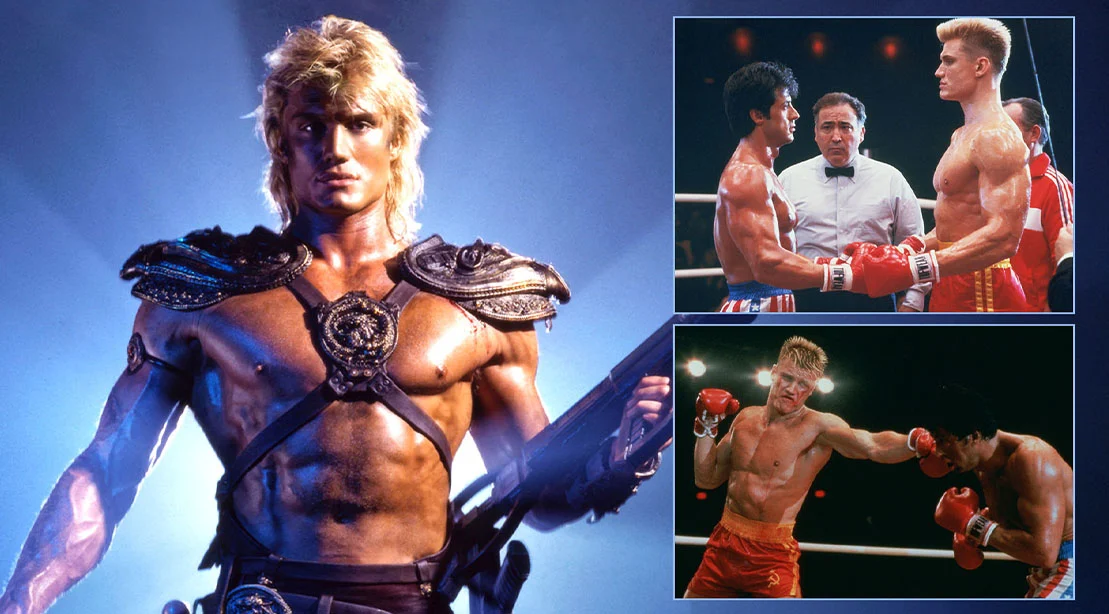
For decades, the name Dolph Lundgren has been synonymous with cinematic invincibility. Standing at an imposing 6’5”, the Swedish-born actor carved his place into the bedrock of action cinema, first as the terrifying Soviet powerhouse Ivan Drago in 1985’s Rocky IV, then as the iconic He-Man in Masters of the Universe, and later as a staple of the Universal Soldier and Expendables franchises. With over a hundred screen credits to his name, he has long been one of the busiest, most physically intimidating figures in Hollywood.
However, beneath the veneer of the indestructible action star lies a man of profound intellect and surprising vulnerability. A Fulbright scholar with a master’s degree in chemical engineering, Lundgren’s life was defined by the discipline of a martial artist and the precision of a scientist. Yet, no amount of training or academic rigor could have prepared him for the most harrowing fight of his life: a secret, decade-long battle with cancer that brought him to the very edge of mortality.
Now, with the release of his candid autobiography, Fights Worth Fighting: Finding Strength in Struggle, and a forthcoming documentary, Dolph: Unbreakable, the 68-year-old icon is stepping out from behind the curtain. He is no longer just the man who challenged Rocky Balboa; he is a survivor sharing the blueprint for enduring the impossible.
The Silent Diagnosis: A Chronology of the Struggle
The story of Lundgren’s health crisis began in 2015, a year that would mark the start of a grueling medical odyssey. Following a routine training session, the actor noticed blood in his urine. Initial testing revealed a cancerous tumor in his kidney. The procedure to remove the growth was successful, and for a period, it seemed the actor had escaped the worst.
However, the nature of his condition was far more complex than initially diagnosed. For five years, Lundgren underwent regular scans and check-ups to ensure the cancer remained in remission. In 2020, those hopes were shattered when a series of follow-up scans revealed that the cancer had returned, with multiple tumors discovered in close proximity to the original site.
The Escalation
The situation grew dire when doctors identified a malignant tumor in his liver. Because of its significant size and location, the tumor was deemed inoperable. Lundgren was placed on a regimen of infusion therapy every three weeks. Despite the treatment, the cancer continued to spread, manifesting in new nodes within his kidney and forcing the actor to manage debilitating side effects, including severe blood clots.
The prognosis grew increasingly grim. At one point, as his health deteriorated, a doctor suggested that his time on Earth was reaching its conclusion, advising the star to spend his final days with his family. It was a moment of profound existential crisis for a man who had spent his life overcoming obstacles on the silver screen.
The Turning Point
Refusing to accept the finality of the diagnosis, Lundgren leveraged his analytical mind and his drive for excellence to seek a second opinion. He turned to UCLA Health, where he consulted with Dr. Alexandra Drakaki. Through advanced genetic testing, Dr. Drakaki discovered a mutation in his tumors that had been previously misidentified.
This critical breakthrough allowed the medical team to pivot to a targeted treatment plan. The results were nothing short of miraculous: the tumors shrank by approximately 90%. With the growth significantly reduced, the remaining cancerous tissue was successfully removed via ablation—a process utilizing heat, cold, and lasers to destroy the malignant cells. By late 2024, the actor was officially declared cancer-free.
Science, Strategy, and the Second Opinion
The medical community often emphasizes the importance of patient advocacy, and Lundgren’s journey serves as a poignant case study. Reflecting on his decision to seek out Dr. Drakaki, the actor describes a moment of intuitive clarity. "I was reluctant to do it at first," he admits. "But I ended up being smart enough to just go ahead and get a second opinion. I just had a feeling about it… it turned out to be the right decision."
This shift in strategy highlights the importance of genomic sequencing in modern oncology. By identifying the specific mutation driving the tumor growth, Lundgren’s team moved from a generalized treatment approach to a precision medicine model. It is a message he carries throughout his new book: the importance of being an active participant in one’s own healthcare.
Maintaining the Edge: Fitness at 68
Even during the darkest phases of his illness, Lundgren refused to abandon the discipline that defined his youth. As a fourth-dan black belt and former European karate champion, the actor views physical maintenance not merely as vanity, but as a fundamental pillar of health.
Strength as a Foundation
"It’s very important, I think, as you get older, to keep your muscle mass, keep your testosterone level up," Lundgren explains. Even at 68, he maintains a rigorous training schedule, balancing three days of weightlifting with ongoing martial arts practice. He credits this foundation of strength as the primary reason he was able to withstand the brutal side effects of his cancer treatments.
For those looking to adopt his philosophy, the advice is simple yet profound: consistency over intensity. He advocates for even short bursts of activity—as little as 30 minutes—conducted away from the sedentary trap of a computer screen. "The strength training really helped me," he notes. "It gave me something to hold onto when everything else felt like it was slipping away."
Implications: A Legacy Beyond the Screen
Lundgren’s transition from action hero to author and advocate is an evolution of his public persona. In Fights Worth Fighting, he explores the emotional toll of his journey, describing the writing process as a form of cathartic therapy.
"You’re going back and re-examining your life," he tells Muscle & Fitness. "It was good for me, because it was a way for me to appreciate the young man who set out from Sweden on some sort of adventure, pay my respects to him to some degree, and internally, just kind of feel good about myself."
Empowering the Audience
The book is not merely a collection of anecdotes about Hollywood; it is a guidebook for those navigating their own medical or personal hardships. Lundgren is acutely aware of the reach he has as a pop-culture icon, and he intends to use that influence to encourage others to "take the fights worth fighting."
Had he not chosen the path of acting, Lundgren speculates he might have pursued a career in academia or coaching. Yet, he finds no regret in his chosen trajectory. "I think it would have been frustrating for me," he admits. "Because I had the creative side of me, and a lot of energy. I think I made the right choice."
Conclusion: The Unbreakable Man
The narrative of Dolph Lundgren is a testament to the resilience of the human spirit. While his films were often exercises in choreographed strength, his life has become a genuine study in endurance. From the classrooms of the Royal Institute of Technology to the high-stakes world of Hollywood, and finally to the sterile halls of oncology wards, he has approached every challenge with the same methodical, unwavering focus.
As he embarks on his book tour and prepares for the 2026 release of Dolph: Unbreakable, the actor serves as a reminder that the most significant battles are often fought in silence, behind closed doors. Whether you are facing a terminal diagnosis or the daily grind of professional life, the lesson from the man who played Ivan Drago is clear: keep training, keep searching for answers, and never stop fighting for your own health.
Dolph Lundgren has survived the impossible, and in doing so, he has found a new, more meaningful role: that of a survivor who refuses to stay down, showing the world that even an icon of strength must find his own way to the light.
For more information on Dolph Lundgren’s book, "Fights Worth Fighting: Finding Strength in Struggle," visit the HarperCollins website. The documentary "Dolph: Unbreakable" is scheduled to stream starting October 6, 2026.