Varese, Italy – July 31st to August 2nd, 2026 – The serene waters of Lake Varese recently played host to the European Rowing Championships, a crucible where Europe’s elite scullers converged to test their mettle. For the Finnish contingent, represented by Maiju Kainlauri and Kasper Hirvilampi, the championships presented a tapestry of both promising breakthroughs and challenging hurdles. The duo, competing in their primary single sculls events and making a significant debut in the newly introduced mixed double sculls, returned with valuable experience and a clear roadmap for the remainder of their season, culminating in the upcoming World Championships in Amsterdam.
The highlight of the Finns’ campaign undeniably centered on their impressive performance in the mixed double sculls, an event making its inaugural appearance at the European level. Kainlauri and Hirvilampi powered through their heats with remarkable synergy, securing a coveted spot in the A-final. This achievement, marking Finland’s first A-final berth in a major international mixed double event, underscored their potential and strategic teamwork. Ultimately, they finished sixth in a fiercely contested final, an outcome that, while not a medal, represented a significant step forward for Finnish rowing. The overall championships were dominated by Romania, a rowing powerhouse that amassed six gold medals, asserting its position as the most successful nation in Varese.
A Pioneering Journey in the Mixed Double Sculls
The introduction of the mixed double sculls to the European Championships marked a progressive stride for the sport, aligning with broader trends towards gender equality and innovative race formats. For Maiju Kainlauri and Kasper Hirvilampi, this new event became the unexpected focal point of their Varese experience, delivering both the highest highs and profound lessons.
From the outset, the Finnish pair demonstrated a compelling blend of power and precision. Their qualification for the A-final was not merely a stroke of luck but a testament to meticulous preparation and an evolving understanding of each other’s rhythm and technique. They navigated the challenging preliminary rounds with composure, showcasing their ability to perform under pressure against seasoned international crews. This early success immediately elevated the spirits within the Finnish camp and garnered attention from competitors and spectators alike.
Kasper Hirvilampi, reflecting on their mixed double performance, articulated the essence of their achievement: "The mixed double was truly outstanding teamwork. A huge thank you to Maiju, a young and incredibly talented athlete. Our preparatory training went exceptionally well, and we had immense faith in ourselves. Crucially, we managed to improve significantly from our World Cup race in Lucerne at precisely the right moment. The reward was an A-final spot."
The A-final itself was a high-stakes affair, featuring the crème de la crème of European mixed crews. Romania, with its deep talent pool, ultimately clinched the gold, demonstrating a commanding performance that set the benchmark for this nascent event. While Kainlauri and Hirvilampi fought valiantly, they ultimately finished sixth. However, the context of their race strategy sheds light on their bold approach.
Hirvilampi elaborated on their tactical decision-making for the final: "An A-final is an A-final, so we decided to go for it with a calculated risk. We couldn’t quite maintain the pace of the leaders, but we executed our plan to the best of our abilities. We faded towards the end, but this was a known possibility when we discussed our tactics. It was a choice between sustaining the pace or fading. We stuck to our own stroke and strategy. The final position likely wouldn’t have changed, and in an A-final at a major championship, you don’t play it safe; you fight and see what happens. Someday, that approach will pay off. We rowed as a team, and that was a truly wonderful experience. From here, our direction is set towards the World Championships in Amsterdam."
Their sixth-place finish, therefore, was not a disappointment but a crucial learning experience. It provided invaluable data on their collective strengths and areas for development, particularly concerning sustained power output against world-class opposition. The experience of competing in a championship A-final, especially in a new discipline, is a significant confidence booster and a critical step in their progression as elite athletes.
Kainlauri’s Rollercoaster in the Women’s Single Sculls
For Maiju Kainlauri, the European Championships in Varese carried an additional layer of significance. Training in Italy, these were in many ways her "home" championships, bringing with them a unique set of pressures and expectations. Competing in the highly competitive women’s single sculls, Kainlauri’s journey was marked by a blend of impressive moments and frustrating setbacks, ultimately culminating in a 14th-place finish.
Her performance in the initial heats of the women’s single sculls was particularly strong, demonstrating her capacity to contend with Europe’s best. These early races showcased her refined technique and raw power, hinting at a potentially deep run into the finals. However, the relentless demands of championship racing, both physically and mentally, proved challenging in subsequent rounds.
Kainlauri herself offered a candid assessment of her experience: "My ‘home’ European Championships in Varese left me with mixed feelings. There were successes and many positives in my starts, such as the single sculls heats and our A-final spot in the mixed double. However, the championships also included missteps, like my own performance in the C-final of the single sculls. From here, we continue to piece together the puzzle on the road to the Finnish National Championships in Tampere and the World Championships in Amsterdam."
Her reflection underscores the fine margins that define elite rowing. A strong heat performance is crucial, but maintaining that intensity and focus through multiple grueling races, often within a tight schedule, is the ultimate test. The C-final, while not the desired A-final, still offered a chance for a strong finish and further competitive experience, and Kainlauri’s self-critical analysis highlights her commitment to continuous improvement.
The women’s single sculls event was ultimately won by Great Britain’s Lauren Henry, who delivered a masterful performance to claim the gold medal. Lithuania’s Viktorija Senkute secured the silver, while Serbia’s Jovana Arsic earned the bronze, rounding out a podium of formidable scullers. Competing against such a high calibre of athletes provides Kainlauri with crucial benchmarks and fuels her determination to close the gap in future competitions.
Hirvilampi’s Contentious Path in the Men’s Single Sculls
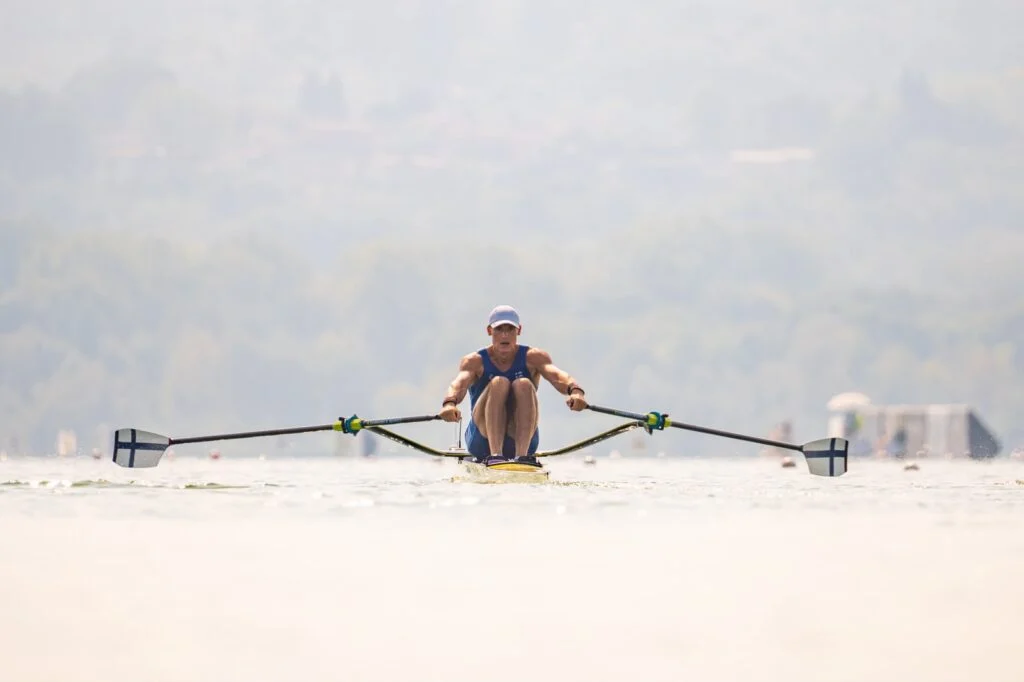
Kasper Hirvilampi’s campaign in the men’s single sculls was perhaps the most dramatic and challenging for the Finnish team, culminating in an 18th-place finish. His races were a testament to resilience, marked by both physical adversity and an unfortunate external interference that sparked controversy.
Hirvilampi’s initial heat proved to be particularly difficult. Battling intense heat and humidity, conditions common in Varese during the summer, he struggled to find his rhythm and execute his race plan effectively. The physical toll of the conditions led to a performance he himself described as "fading badly" and "subpar," acknowledging that while the conditions were the same for all, his individual response wasn’t optimal.
However, Hirvilampi demonstrated remarkable character and adaptability in his subsequent races. By the time of the C-final, he had clearly regrouped, learning from his earlier struggles. He found a new gear, feeling stronger and more in control. "In the C-final, I had completely different legs and a different mindset, having learned from my mistakes," he noted. "The level was what it needs to be at a major championship, and there were truly tough names on every lane. I had a really good race up until the last 900 meters."
It was at this critical juncture that external factors intervened. Waves generated by a race official’s catamaran, operating too close to the racing lanes, severely disrupted the race. Hirvilampi, along with other competitors, found themselves struggling to maintain balance and rhythm in the turbulent water. "Unfortunately, even here, we didn’t get through cleanly. Disturbing waves came from the organizers’ catamaran in the middle of the race, and the race was essentially ruined by that. We were all rocking in the waves one after another," Hirvilampi recounted with palpable frustration.
The incident was significant enough to prompt a collective protest from the affected athletes. Initially, the judge overseeing the race recognized the severity of the interference, signaling a red flag – typically an indication of a major rule infringement or cancellation. However, after deliberation, the jury ultimately decided to let the results stand, a decision that left many athletes, including Hirvilampi, feeling aggrieved.
Despite the unfortunate circumstances, Hirvilampi maintained a positive outlook. "It was still a promising performance, and this is a good foundation to build upon. The speed is clearly there." This resilience and focus on the positives, even in the face of unfairness, speaks volumes about his professional approach.
The men’s single sculls gold medal was claimed by Germany’s Oliver Zeidler, a dominant force in the event. Yauheni Zalaty, competing as an Authorized Neutral Athlete (AIN), secured the silver, while Greece’s Stefanos Ntouskos took home the bronze. Hirvilampi’s ability to compete at such a high level, even with external interference, suggests that his speed and potential are indeed significant.
The Broader Context: Varese as a Rowing Epicenter
The European Rowing Championships in Varese were more than just a series of races; they were a grand spectacle set against the backdrop of one of Italy’s most picturesque rowing venues. Lake Varese is renowned in the international rowing community for its stable conditions and excellent facilities, making it a frequent host for major championships, including previous World Cups and World Championships. This familiarity with the venue often provides athletes with a sense of comfort, yet the unpredictable nature of summer weather, as evidenced by the intense heat and unexpected waves, always keeps competitors on their toes.
The championships showcased the depth of talent across Europe, solidifying the continent’s position as a global leader in the sport. Romania’s performance, securing six gold medals, was particularly dominant, underscoring their robust development programs and consistent pipeline of world-class athletes. Their success across multiple boat classes served as a powerful reminder of the standards required to compete at the very pinnacle of international rowing. Other nations like Great Britain and Germany also demonstrated their strength, with commanding victories in key events.
For the Finnish team, competing at such a high-calibre event offers invaluable experience. It exposes them to the latest techniques, the relentless pace of international racing, and the mental fortitude required to perform under immense pressure. The European Championships serve as a crucial stepping stone, not just for the immediate season but also for long-term athlete development and preparation for the Olympic cycle.
Implications and the Road Ahead: Amsterdam World Championships
The Varese European Championships have provided the Finnish rowing team with a wealth of insights and a clear trajectory for the remainder of their crucial season. The performances of Maiju Kainlauri and Kasper Hirvilampi, particularly their groundbreaking A-final appearance in the mixed double sculls, offer significant encouragement and tangible proof of their progress.
The lessons learned from Varese are already being integrated into their training regimen. For Kainlauri, the focus will be on maintaining consistency throughout multiple races and fine-tuning her performance in the critical later stages of a competition. For Hirvilampi, the key will be to harness his evident speed and mental resilience, ensuring that external factors do not derail his impressive capabilities. The controversial wave incident, while frustrating, has likely fortified his mental toughness and ability to adapt.
The immediate next step for the Finnish rowers is the domestic Finnish National Championships in Tampere, scheduled for August 15-16. This event will serve as a final tune-up, allowing them to test their form and refine their race strategies in a competitive environment before the ultimate challenge.
Following Tampere, the focus shifts entirely to the World Rowing Championships, set to take place in Amsterdam from August 24-30. Both Maiju Kainlauri and Kasper Hirvilampi will once again compete in their respective single sculls and the mixed double sculls. The World Championships represent the pinnacle of the annual rowing calendar, drawing the best athletes from around the globe, and will be an even more demanding test than the European Championships.
Crucially, the Finnish team will be strengthened at the World Championships by the inclusion of Juho-Pekka Petäjäniemi, who will compete in the men’s lightweight single sculls. Petäjäniemi’s addition adds another dimension to the Finnish presence, showcasing the growing breadth of talent within the national rowing program. His performance will be keenly watched, as lightweight categories require a unique blend of endurance, power, and precise weight management.
The journey from Varese to Amsterdam is not just about physical preparation; it’s about mental fortitude, strategic adaptation, and unwavering belief. The mixed emotions expressed by both Kainlauri and Hirvilampi after Varese are characteristic of elite athletes who constantly strive for perfection. Their ability to acknowledge challenges while simultaneously drawing strength from their successes bodes well for their future endeavors.
"Now is a good time to start the final hard training block," Hirvilampi concluded, encapsulating the forward-looking mindset of the entire team. The experiences gained, the speed demonstrated, and the challenges overcome in Varese will undoubtedly fuel their preparations for Amsterdam, where they aim to translate their promising European performances into even greater international achievements. The Finnish rowing community watches with keen anticipation as their athletes embark on the next crucial phase of their competitive journey.
Results and race videos from the Varese European Championships can be found via the official World Rowing link: https://worldrowing.com/event/2026-european-rowing-championships/
Images: Balint Czucz