Responding to environmental emergencies is inherently hazardous, but when the mercury drops and waterways freeze, the complexity of spill containment multiplies exponentially. Inland spill response during winter months represents one of the most technical and unforgiving challenges in the emergency management sector. Whether mitigating a chemical release or containing a hydrocarbon spill in a river system, responders are no longer just fighting the pollutant—they are battling the physical, psychological, and environmental rigors of the deep freeze.
The High-Stakes Environment of Frozen Waterways
The primary directive in any spill response is safety; in winter, this mandate becomes a tactical struggle against the elements. While standard operating procedures (SOPs) are robust for open-water scenarios, they must be fundamentally re-engineered for operations on or near ice.
Working on river ice is significantly more treacherous than operating on frozen lakes. In a lake, the water beneath the ice is generally stagnant; if a responder breaks through, they remain in a localized, albeit freezing, environment. In a river, the dynamic current creates a "conveyor belt" effect. A responder who breaches river ice faces the immediate risk of being swept beneath the shelf, a life-threatening scenario that leaves virtually zero margin for error. Consequently, the industry standard is to avoid ice-based operations whenever possible. However, when environmental containment demands it, the operation must be treated with the same rigorous risk management applied to high-angle rescue or hazardous materials (HAZMAT) remediation.
Chronology of an Ice-Based Response: From Assessment to Execution
The success of an ice-based spill operation is predicated on the "Size Up" phase. No personnel should set foot on an ice shelf until a comprehensive safety plan has been finalized, vetted by an ice-rescue instructor, and communicated to every member of the response team.
Phase I: Initial Size Up and Risk Assessment
Before any equipment is deployed, the Incident Commander (IC) must oversee a multi-faceted assessment of the site. This involves:
- Current Velocity Analysis: Evaluating the speed of the water beneath the ice to determine the potential for "undercutting" and the trajectory of potential drift.
- Hydraulic Depth Assessment: Understanding the depth of the water column to determine the severity of a potential immersion event.
- Ice Integrity Testing: This is the most critical technical step. Responders must evaluate thickness, crystalline quality, and structural consistency.
- Load-Bearing Calculations: Utilizing the P=50 x T² formula (where P is capacity in pounds and T is thickness in inches), responders calculate the load-bearing capacity of the ice.
Phase II: The Progressive Approach
Responders must never move blindly into a spill zone. The standard procedure requires a series of test holes drilled from the safety of the shoreline, progressively moving outward toward the center of the response area. During this phase, responders must be belayed at all times. The use of weight-distribution platforms, such as 4×8 sheets of marine-grade plywood or specialized inflatable work platforms, is mandatory to disperse the force exerted on the ice surface.
Phase III: Sustained Operations and Containment
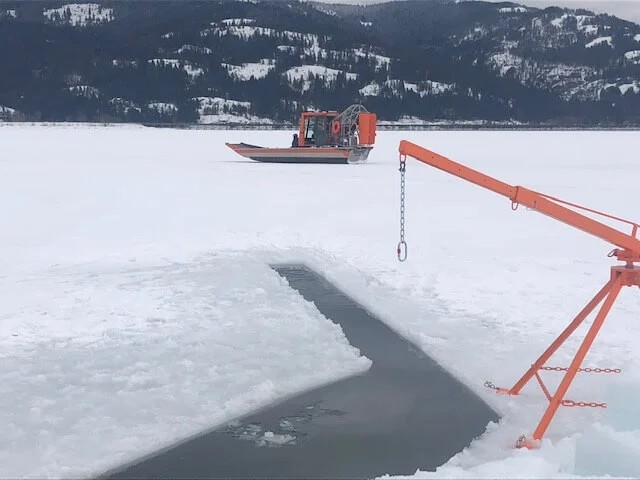
Once the site is deemed viable, the focus shifts to containment. This involves cutting slots for boom deployment. These cuts must be clearly demarcated with protective fencing and high-visibility lighting. Because river ice is prone to shifting, continuous monitoring of weather and ice integrity is required throughout the duration of the response.
Supporting Data: Understanding Ice Dynamics
Ice is not a monolithic substance; it is a complex material that reacts differently to temperature fluctuations, water chemistry, and mechanical stress. Effective response depends on identifying the specific type of ice present:
- Lake Ice (Black/Clear Ice): The gold standard of ice strength. It forms rapidly during sharp temperature drops and is the most reliable surface for heavy equipment.
- Frazil Ice: A slurry of disk-shaped crystals that forms in turbulent water. It is unstable and provides poor structural support.
- Candled Ice: A result of structural deterioration. It may appear thick, but it possesses the integrity of a series of vertical columns, making it extremely brittle and dangerous.
- Snow Ice: Formed when snow saturates the ice surface and freezes. It is opaque, milky in appearance, and significantly weaker than clear ice.
- Anchor Ice: Unique to river systems, this forms on submerged objects. It can trigger unexpected ice jams, causing rapid changes in water levels and pressure beneath the surface ice.
The Impact of Environmental Variables
Responders must apply a "Safety Factor" to all ice strength calculations. Guidelines suggest that while 4 inches of clear ice may support a person for skating, 7–8 inches are required for a medium-sized truck. Crucially, these figures must be reduced by 15% to account for the erosive power of river currents and by up to 50% if the ice is classified as "snow ice."
Official Protocols and Equipment Requirements
A professional response requires a dedicated suite of specialized gear. PPE is the final line of defense and must include drysuits, rated PFDs (Personal Flotation Devices), ice awls for immediate self-rescue, and non-slip traction cleats.
Infrastructure of the Response Zone
The Incident Command must establish a "Warming Station" as a mandatory component of the site layout. This facility serves as an essential medical intervention point, equipped with:
- Hypothermia-Wraps and blankets
- AEDs and Oxygen supplies
- Portable heating units to mitigate frostbite
- Spare PPE (boots/gloves) to replace saturated gear
The "Buddy System" is the backbone of these operations. No responder works alone. Each member of the team must have a dedicated observer tasked with monitoring their physical condition and the status of the ice beneath them.
Implications: The Role of Wind Chill in Site Safety
While the physical stability of the ice is the primary mechanical concern, the physiological impact of the ambient environment is equally critical. The Wind Chill Temperature Index (WCTI) serves as the primary metric for assessing the danger to human personnel.
As wind speed increases, the rate of heat loss from exposed skin accelerates dramatically. In extreme scenarios—often encountered during inland spill responses in northern climates—frostbite can occur in under one minute. Incident Commanders must consult the Wind Chill Chart hourly. If the "feels like" temperature crosses established safety thresholds, work must be suspended or rotated to ensure that personnel are not subjected to dangerous cooling.
Self-Rescue: The Last Resort
Every responder must be trained in ice self-rescue. Should a member fall through, the protocol is clear:
- Suppress the Panic Reflex: A controlled entry into the water allows for a more calculated exit.
- Horizontal Deployment: Extend arms wide across the ice surface to prevent total submersion and leverage the body weight.
- Kick and Pull: Utilize the legs to achieve a horizontal position in the water, then kick aggressively while pulling the torso onto the ice shelf.
- Roll to Safety: Once the torso is on the ice, roll away from the breach point to distribute weight until the responder reaches stable ground.
Conclusion: A Culture of Vigilance
Inland spill response in winter is an exercise in extreme risk mitigation. It demands an appreciation for the subtle, often invisible, changes in river dynamics. By adhering to strict assessment protocols, utilizing proper weight distribution, and maintaining a rigid command structure that prioritizes the health and thermal regulation of its responders, agencies can successfully manage environmental crises even in the most hostile winter conditions.
The mantra for all personnel remains constant: Assessment before action. In the unforgiving environment of frozen rivers, speed is never a substitute for the deliberate, methodical process of ensuring that every responder returns from the ice safely. Whether managing a minor fuel leak or a major hazardous material incident, the integration of science, engineering, and human safety protocols is what distinguishes a successful operation from a catastrophic one.