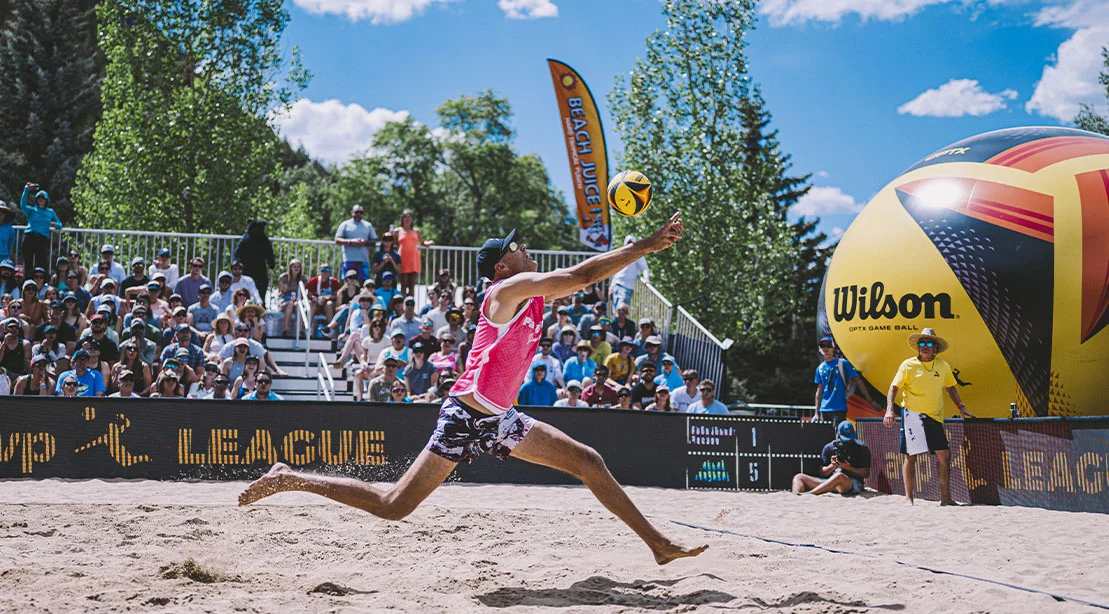
After nearly 25 years of dominating the sand, Olympic gold medalist Phil Dalhausser has arrived at a professional conclusion that defies the conventional wisdom of the modern sports industry: greatness is not found in the relentless accumulation of volume. Instead, for the 6’9” beach volleyball icon, longevity is an exercise in subtraction—the art of knowing exactly what moves the needle and the discipline to discard the rest.
While the average professional career in high-impact sports often burns out within a decade, Dalhausser has remained a fixture at the pinnacle of beach volleyball well into his 40s. He stands as a rare exception in a sport that typically demands youthful recovery speeds and punishing training cycles. His continued success offers a masterclass in how experience, strategic recovery, and a recalibrated mindset can outweigh the raw, unrefined talent of younger competitors.
The Philosophy of "Train Smarter, Not Harder"
In an era where athletes are encouraged to track every heartbeat and optimize every calorie, Dalhausser’s formula for staying competitive is almost radical in its simplicity. While his younger peers fill their calendars with back-to-back conditioning sessions, heavy weightlifting blocks, and high-volume repetitions, Dalhausser has fundamentally shifted his focus from building his body to preserving it.
"I’m definitely training way different than everyone else," Dalhausser explains. "I’ve put in the time and the reps over the last two decades. Now, I stay in shape in the gym and practice maybe once a week or so."
This approach is not a sign of waning ambition; it is the culmination of 24 years of trial, error, and hard-won wisdom. For Dalhausser, the goal is no longer to push his physical limits to the brink of exhaustion but to maintain the structural integrity required to perform at an elite level on match days.
Training for Explosion, Not Exhaustion
For the veteran athlete, the gym is no longer a place to chase personal records or build hypertrophy. Instead, his training is surgical. He recognizes that his primary asset as a blocker and attacker is his explosive power—the ability to elevate, react, and generate force instantly.
"I’m trying to preserve the little bit of explosiveness I have left," he says with a characteristic laugh. "That’s basically it."
The Mechanics of Efficiency
Dalhausser’s training regimen centers on Olympic-style movements, specifically clean pulls. These exercises prioritize the development of triple extension through the ankles, knees, and hips—the kinetic chain required for elite-level jumping. By focusing on intent and velocity rather than sheer load, he maintains his fast-twitch muscle fibers without the systemic inflammation that accompanies heavy, maximal lifting.
Every session is filtered through a singular, pragmatic lens: Will this help me perform on the weekend? If a movement risks unnecessary fatigue or fails to translate directly to the court, it is removed from the program.
The "Garage Gym" Environment
His training environment is a testament to his no-frills mentality. Eschewing the climate-controlled, state-of-the-art facilities common among professional athletes, Dalhausser trains in his Orlando garage. During the brutal Florida summers, the space becomes a furnace.
"It’s two million degrees in there," he jokes. "But I warm up in five minutes."
The heat serves as an unintended, yet effective, training partner. It forces him to adapt to discomfort and keeps his cardiovascular system primed for the grueling conditions of the AVP tour. There is no luxury, no elaborate setup—just a barbell and a system refined over thousands of matches.
The Evolution of Recovery
If there is one area where Dalhausser has undergone a total transformation, it is in his approach to post-match recovery. In his early years, recovery was a secondary thought; now, it is the backbone of his career.
The Role of Yoga
After returning from the intensity of an AVP competition weekend, Dalhausser’s first priority is a 45-minute vinyasa flow session. "I feel like a new man afterwards," he says. "Yoga checks all the boxes for me—body and mind." By integrating mobility and mindfulness, he addresses the stiffening effects of age and travel far more effectively than he ever did with standard foam rolling or passive stretching.
The Wearable Tech Debate
In a fitness culture obsessed with data, Dalhausser stands apart as a skeptic of modern wearables. While many athletes allow algorithms to dictate their training intensity based on "readiness scores," Dalhausser relies entirely on internal intuition.
"I don’t need some device to tell me if I slept well," he asserts. "I know when I wake up if I’m tired or not."
He warns that the psychological pressure of tracking can actually become a detriment. If an athlete wakes up feeling refreshed but is told by an app that their sleep quality was poor, they often manifest fatigue that wasn’t there to begin with. His philosophy is simple: listen to the body, not the watch.
Learning from Every Injury
Dalhausser’s longevity is also defined by his relationship with pain. Over nearly a quarter-century, injuries have been inevitable—from elbow issues to persistent calf strains and lower back flare-ups. However, he views these not as failures, but as data points.
"The more different injuries I have, the more you learn about how to deal with that kind of stuff," he says. "Injury is a way to learn more about your body."
For instance, after a nagging calf strain sidelined him, he didn’t just rehab the muscle; he identified a flaw in his serving mechanics that was causing the imbalance. By fixing the root cause rather than just treating the symptom, he prevents recurrence. It is a process of constant recalibration.
The Mental Edge: Meditation and Stoicism
If there is a "secret sauce" to Dalhausser’s career, it is his dedication to meditation. Initiated a decade ago, his practice has provided the emotional stability required to handle the high-pressure environment of world-class competition.
"Our mind can be our biggest enemy," Dalhausser notes. "Once you realize you’re not the mind, but the observer, the whole world is a different place."
The "Suffering Bar"
During tournaments in extreme conditions, such as the intense heat of Las Vegas, Dalhausser employs a psychological tactic he calls setting the "suffering bar." He mentally prepares for the worst-case scenario—total exhaustion, heat, and physical pain—before he even steps onto the sand. By setting his expectations at the absolute floor, the reality of the match often feels manageable by comparison.
Navigating Partnership Dynamics
His mental discipline also extends to his professional partnerships. He acknowledges that earlier in his career, frustration with a teammate’s style could sabotage his performance. Today, he views those difficult dynamics as "spiritual teachers." His current partnership with Trevor Crabb serves as a prime example of how positive reinforcement and shared confidence can reignite a career, even after periods of stagnation.
Implications for the Next Generation
Dalhausser’s impact now extends beyond his own results. Together with his wife, he operates a junior beach volleyball club in Orlando, attempting to foster a culture of longevity in a region traditionally dominated by indoor volleyball.
His advice to the next generation is consistent with his own evolution: do not be obsessed with instant mastery. He tells his students that frustration is not a sign of failure, but a part of the learning process. He encourages young athletes to be curious about their errors rather than crushed by them.
Conclusion: The Long Ride
Phil Dalhausser’s career is a testament to the fact that excellence is not a sprint, but a sustained, thoughtful, and evolving practice. He has achieved the highest honors the sport has to offer—Olympic gold, world titles, and legendary status—but he measures his current success by his ability to remain in the game and his capacity to give back.
Longevity, in his view, isn’t about simply surviving the sport. It is about continuously learning from it, adjusting to the inevitable changes that time inflicts on the human body, and maintaining the mental clarity to enjoy the journey. After 24 years, he remains not just a competitor, but a student of the sand, proving that while the body may age, the ability to adapt is timeless.