For decades, the solar surface—that roiling, incandescent sphere of superheated plasma—was viewed through a lens of relative simplicity. While scientists knew the sun was a violent, dynamic engine of magnetic activity, the fine-scale mechanics of its upper atmosphere remained largely theoretical. This week, that veil of mystery has been pierced. The Daniel K. Inouye Solar Telescope (DKIST), perched at the summit of the Haleakalā volcano in Hawaii, has provided the first definitive visual evidence of tiny plasma vortices, confirming a physical phenomenon predicted over a century ago: the Kelvin-Helmholtz instability.
This discovery is not merely a triumph of optical engineering; it is a fundamental shift in our understanding of how the sun behaves at the smallest, most chaotic scales.
The Main Event: A New Portrait of the Star
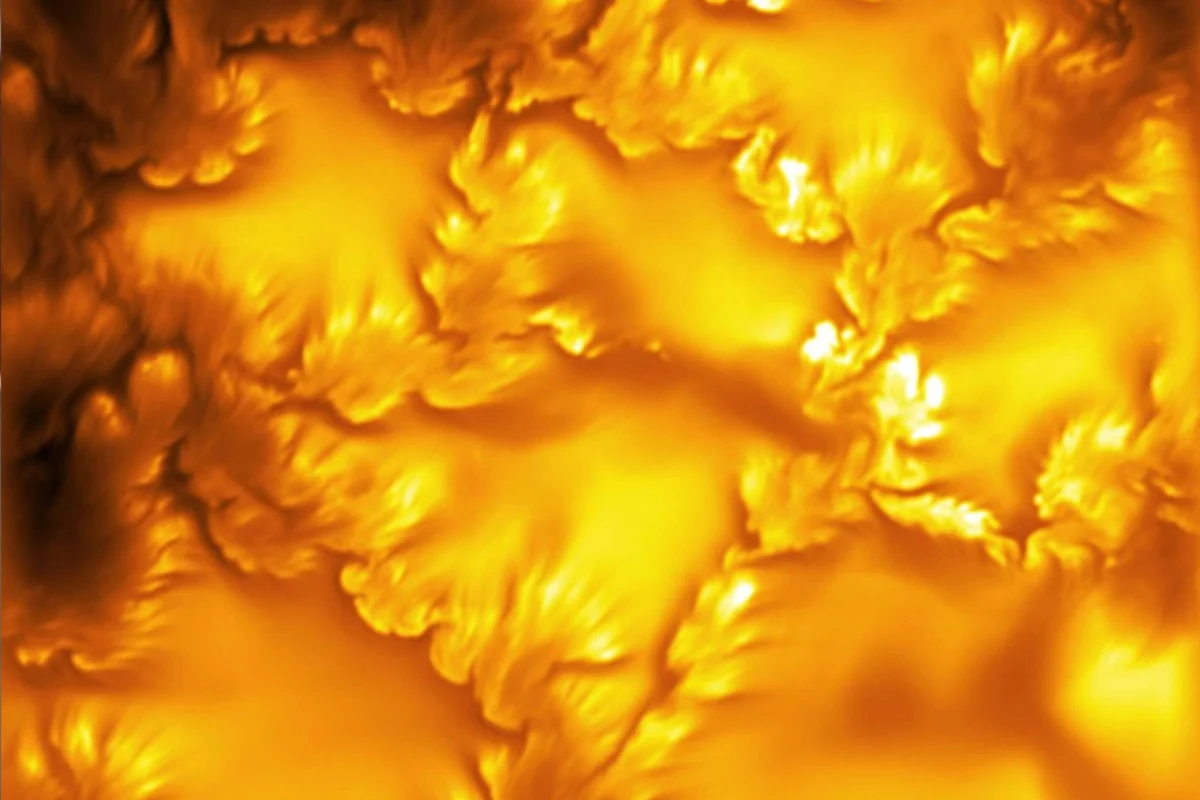
The images shared by NASA and the National Solar Observatory (NSO) offer a view of the sun that is starkly different from the filtered, neon-colored composites typically produced by space-based observatories. While missions like the Solar Dynamics Observatory (SDO) capture the sun in ultraviolet or X-ray wavelengths—revealing the invisible, high-energy structures that define solar weather—the Inouye telescope has captured the sun in visible light.
If a human observer were capable of shielding their eyes from the sun’s blinding, lethal radiance, this is what they would see: a landscape of complex, petal-like structures, swirling eddies, and intricate folds. It is a surface that appears almost organic, mimicking the fluid dynamics of a terrestrial ocean rather than the sterile, gaseous sphere often depicted in textbooks. These "petals" are the signature of the Kelvin-Helmholtz instability, a phenomenon that occurs when two layers of fluid move past one another at different velocities, creating friction that causes the boundary to curl, ripple, and eventually break into vortices.
Chronology of a Scientific Pursuit
The theoretical groundwork for this observation dates back to the late 19th century. Lord Kelvin and Hermann von Helmholtz, two giants of classical physics, independently developed the mathematical framework to explain why boundaries between fluids of different densities or speeds become unstable.
For over 100 years, this theory was applied to everything from ocean waves and cloud formations on Earth to the bands of gas surrounding Jupiter. Solar physicists, however, were left to wonder: if the sun is essentially a massive ball of plasma—a conductive fluid—should it not exhibit these same instabilities?
- The Early 20th Century: The Kelvin-Helmholtz theory is established, but observational technology is too primitive to see beyond the sun’s macro-features.
- The Space Age (1960s–1990s): Solar telescopes move to orbit to escape atmospheric distortion. While we begin to map the solar corona and sunspots with unprecedented clarity, the fine-scale turbulence of the surface remains just out of reach.
- 2020: The Daniel K. Inouye Solar Telescope reaches "first light." Its four-meter primary mirror, the largest in the world for solar observation, begins the arduous process of commissioning.
- 2026 (Present Day): After years of calibration and the development of advanced adaptive optics to counteract the Earth’s turbulent atmosphere, the telescope captures the high-resolution data necessary to identify the tiny, fleeting vortices that define the Kelvin-Helmholtz instability on the solar surface.
Supporting Data: The Physics of Plasma
To understand the significance of these images, one must understand the nature of the solar environment. The sun is not a solid object; it is a roiling, convective, magnetic mess of plasma. In this state, gas is so intensely hot that electrons are stripped from their atoms, leaving a soup of charged particles that respond violently to magnetic fields.
The vortices observed by the Inouye telescope are relatively "small"—measuring just a few dozen kilometers in diameter. In the context of the sun, which has a diameter of roughly 1.4 million kilometers, these structures are mere whispers of motion. However, their ubiquity suggests they are a primary mechanism for energy transfer.
According to researchers at the National Solar Observatory, these vortices form and dissolve in a matter of seconds. They represent the "friction" of the sun, where energy from the deep interior is churned toward the surface. Because the image spans approximately the radius of the Earth, it provides a frame of reference that highlights the sheer scale of the energy involved. These small-scale interactions are the "missing link" in understanding how energy is injected into the solar corona.

Official Responses and Scientific Context
"We have always known these structures were likely there," says a spokesperson for the National Solar Observatory. "The challenge has never been theoretical—it has been technological. We needed a telescope capable of resolving detail on the order of a few dozen kilometers from a distance of 150 million kilometers. The Inouye is the first instrument to bridge that gap."
NASA’s involvement, alongside the National Science Foundation, emphasizes the importance of this data for space weather forecasting. The solar corona—the sun’s outer atmosphere—is significantly hotter than the surface, a mystery that has puzzled scientists for generations. By observing how these small-scale instabilities move energy through the photosphere, researchers hope to better understand the heating mechanisms that drive the corona to temperatures of millions of degrees.
Implications: Protecting Our Electronic Civilization
Why does a swirl of plasma on the surface of the sun matter to an office worker in New York or a power grid operator in Tokyo? The answer lies in the solar corona and its capacity for destruction.
The sun is the primary driver of "space weather." When magnetic fields in the solar corona become twisted and unstable, they can snap and reconnect, releasing colossal amounts of energy in the form of coronal mass ejections (CMEs). These bursts of charged particles, when directed toward Earth, collide with our planet’s magnetosphere. The result can be a geomagnetic storm capable of disabling satellites, disrupting global positioning systems (GPS), and overwhelming terrestrial power grids.
By confirming the existence of Kelvin-Helmholtz instabilities, scientists have added a critical variable to their predictive models. These vortices are essentially the "turbulence" that influences how magnetic energy is transported from the sun’s interior to the corona. If we can better model the turbulence at the surface, we can better predict the buildup of tension in the magnetic fields above.
"This is about more than just a pretty picture," noted one solar physicist involved in the project. "It is about understanding the fundamental physics of the star that sustains us, and the one that occasionally threatens to disrupt our modern way of life. Every vortex we map is a step toward a more robust space-weather warning system."
A New Era of Solar Astronomy
The images provided by the Inouye Solar Telescope represent the dawn of a new era. For the first time, we are moving from static, global views of the sun to a dynamic, high-resolution understanding of its surface mechanics.
As the telescope continues its mission, scientists expect to capture even more detailed data on how these vortices interact with sunspots and magnetic filaments. The "petals" visible in the current imagery are merely the beginning. They are the footprints of a much larger, invisible process—a dance of magnetic energy that has been occurring for four and a half billion years, and which we are only now beginning to watch in real-time.
The sun, once viewed as a constant, unchanging disk in the sky, is being revealed as a vibrant, shifting, and deeply complex environment. As we look at these new, razor-sharp images, we are reminded that even our nearest star holds secrets that require the best of human ingenuity to uncover. The century-old prediction has been confirmed, but the journey to fully map the sun’s chaotic surface is only just beginning.