While Crete is globally synonymous with the sapphire waters of the Aegean and the remnants of Minoan civilization, its rugged interior tells a different, more primal story. Rising sharply from the coastline, the White Mountains (Lefka Ori) stand as a monolithic barrier, home to over 30 summits exceeding 2,000 meters. Tucked within this limestone labyrinth lies the Samaria Gorge—a geological masterpiece that serves not only as one of Europe’s premier hiking destinations but as a profound monument to Cretan resilience.

Main Facts: A Geological and Historical Titan
Measuring 16 kilometers (9.9 miles) from the high-altitude trailhead of Xyloskalo down to the Libyan Sea at Agia Roumeli, the Samaria Gorge is widely regarded as one of the most spectacular canyons in Europe. With walls that soar up to 300 meters (984 feet) in height and, at its narrowest point—the "Iron Gates"—narrowing to a mere three meters, the gorge offers an immersive experience in raw, vertical geography.

The site is more than a natural wonder; it is a cultural sanctuary. Historically, the gorge provided a natural fortress for local populations during centuries of foreign occupation. Whether hiding from Venetian raiders or Ottoman forces, the Cretan people found in these deep, inaccessible limestone corridors a place where they could maintain their autonomy. In 1962, recognizing its unique biodiversity and historical significance, the Greek government designated the area a National Park. Today, it stands as a protected habitat for the Kri-kri (Cretan goat), a symbol of the island’s wild heritage.

Chronology: A Day in the Depth of the White Mountains
The experience of the Samaria Gorge is best understood through the lens of a traversal. For those seeking the classic experience, the journey begins at the Xyloskalo ticket office.

Early Morning (06:00 – 08:00):
The descent begins with a series of steep, switchbacking paths carved into the mountainside. As the sun rises over the eastern peaks, the limestone summits—which earn the "White Mountains" name through their reflective, bald appearance in summer and snow-capped peaks in winter—begin to glow.

Mid-Morning (09:00 – 11:00):
At the 4-kilometer mark, hikers reach the rest area of Ayios Nikolaos. This site is a microcosm of Cretan history, featuring a centuries-old chapel and a grove of ancient cypress trees. Archaeological evidence suggests this location held significance as far back as the 1st Century B.C., when it served as a temple dedicated to the god Apollo.

Midday (12:00 – 14:00):
The trail reaches the abandoned village of Samaria. Once a vibrant mountain community, the village was evacuated upon the area’s designation as a National Park in 1962. Today, the stone structures are maintained as a medical center and a base for park rangers and researchers. It is the natural halfway point for the journey, offering a moment of reflection amidst the silence of the canyon floor.

Afternoon (15:00 – 17:00):
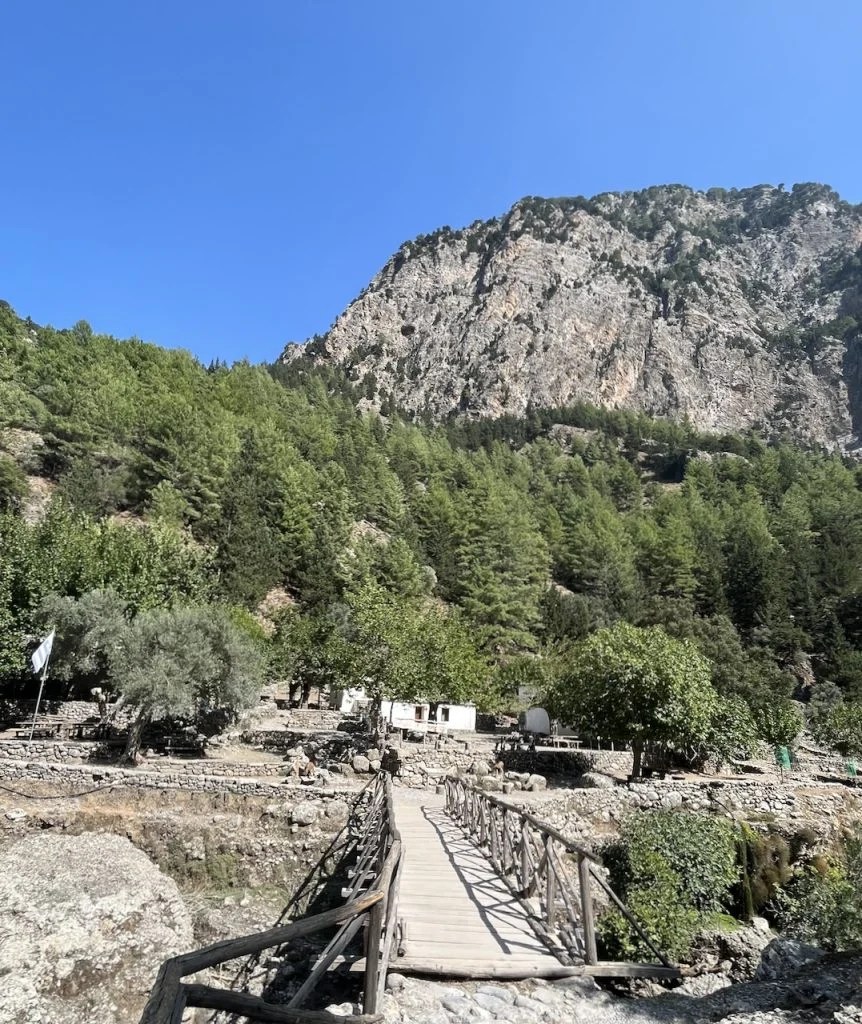
The landscape shifts dramatically as the trail enters the riverbed. This is the most technically demanding and visually striking portion of the trek. Here, the "Iron Gates" narrow the sky to a sliver. Navigating this section involves traversing the watercourse via stepping stones and wooden bridges, creating an intimate encounter with the sheer scale of the rock walls. The exit at the southern gate leads to a final two-kilometer stretch toward the village of Agia Roumeli, where the trek concludes on the shores of the Libyan Sea.

Supporting Data: Trail Logistics
For the modern adventurer, the Samaria Gorge is a well-managed but physically demanding undertaking.

- Distance: 14.5 km (8.9 miles) from the primary trailhead.
- Elevation Dynamics: The hike is characterized by a significant descent of 2,327 meters (7,635 feet), while the total elevation gain is 1,099 meters (4,285 feet).
- Duration: The average hiker completes the trek in 5 to 6 hours.
- Infrastructure: Potable water is readily available at multiple stations along the route, and the trail is well-maintained by park authorities.
- Accommodation: Local mountain lodgings, such as the historic Hotel Neos Omalos, provide essential staging points for hikers planning an early start.
Official Responses and Bureaucratic Challenges
The management of the Samaria Gorge is a delicate balance between public access and environmental preservation. Park officials maintain a strict schedule to ensure hiker safety, particularly regarding the risk of flash flooding or heat exhaustion.

A recent, unconventional attempt to hike the gorge as an "out-and-back" return journey highlighted the rigorous nature of these oversight protocols. In the fall of 2023, hikers attempting to traverse the full 32-kilometer round trip faced skepticism from park officials. The official mandate is for the gorge to be cleared by 18:00; those attempting a double-crossing are often viewed with suspicion by staff, who prioritize the safety of the daily influx of one-way trekkers.

Throughout this experiment, rangers at various checkpoints expressed varying degrees of concern. While the initial resistance from officials was based on strict adherence to safety timelines, successful communication—providing evidence of pace and preparedness—eventually garnered the respect of the local staff. This interaction underscores the importance of respecting the authority of park officials, who manage a challenging, remote, and often unforgiving environment.

The Kri-kri: Guardians of the Gorge
No discussion of the Samaria Gorge is complete without mention of the Kri-kri, or Cretan goat. These animals are a biological anomaly; they are not strictly indigenous but are believed to have been introduced during the Minoan civilization (3100–1100 B.C.).

By the 1960s, the species was on the brink of extinction, with fewer than 200 individuals remaining. The establishment of the National Park acted as a critical turning point. Today, the population has rebounded to over 2,500. Their ability to navigate near-vertical cliffs and leap across gaps exceeding six meters makes them the true masters of the canyon. Their presence serves as a testament to the success of habitat protection, turning the gorge into a living laboratory for wildlife conservation.

Implications: A Legacy of Resistance
The Samaria Gorge is more than a tourist destination; it is an enduring symbol of the Cretan spirit. The story of 4,000 women and children finding refuge in the gorge during the 1770 uprising, and the subsequent defense of the Iron Gates by 200 fighters, is ingrained in the local consciousness.

For the modern traveler, the gorge offers an opportunity to engage with history through physical exertion. It forces a change in perspective: looking up at the sky through a narrow corridor of rock, one cannot help but feel the weight of the centuries.

Final Thoughts for the Traveler
The Samaria Gorge is featured in Wanderlust Mediterranean, a collection published by Gestalten that explores the most evocative landscapes of the region. As with any environment of such majesty and sensitivity, it is essential for hikers to practice "Leave No Trace" principles. Whether you are seeking a record-breaking challenge or a peaceful walk through history, the gorge remains a vital, beating heart of the Cretan landscape—a place where the earth itself tells a story of survival, freedom, and the sheer power of nature.

For those planning a visit, ensure you check current park regulations, weather reports, and opening dates, as the canyon is typically only accessible from late spring to late autumn, depending on snowmelt and environmental safety conditions.